Instagram Growth Engineering — Part 16
Short Answer
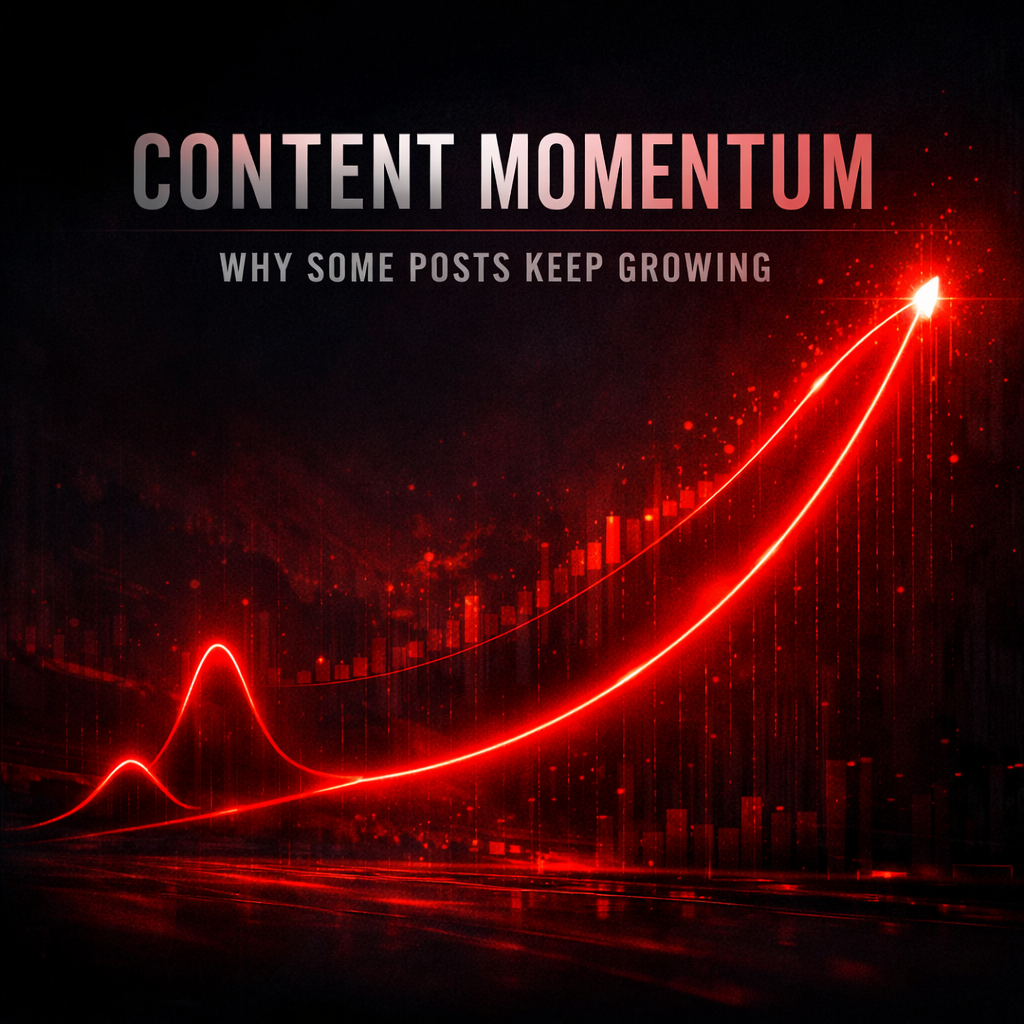
Content momentum is the algorithm’s way of measuring whether a post is gaining strength over time, not just performing well in a single moment.
It’s not about how fast a post starts.
It’s about whether its signals remain consistent, stable, and growing after the initial push.
Posts don’t die because they are bad.
They die because their momentum collapses.
Key Takeaways
-
Momentum is different from engagement velocity
-
It’s based on trend direction, not just total engagement
-
Late engagement signals (saves, shares, rewatches) carry higher weight
-
Strong momentum extends distribution windows
-
Weak momentum leads to early content decay
-
The algorithm prefers stability over spikes
Deep Analysis
I. Velocity Starts the Process — Momentum Decides the Outcome
Most creators are trained to think in terms of speed.
“How fast did my post get likes?”
“How did it perform in the first 30 minutes?”
This is velocity.
And yes — velocity matters.
But velocity is only the entry signal.
Momentum is what determines whether the algorithm continues investing in your content.
Think of it this way:
Velocity = ignition
Momentum = sustained force
A post with strong velocity but no momentum will spike… then disappear.
A post with moderate velocity but strong momentum will compound over time.
II. The Algorithm Tracks Direction, Not Just Volume
Most people misunderstand engagement metrics.
They think:
more likes = better performance
But the algorithm is not just measuring how much engagement you get.
It is measuring how engagement evolves over time.
This is where momentum lives.
Consider two posts:
Post A: 300 → 80 → 20
Post B: 100 → 120 → 150
Post A looks stronger at first.
But Post B shows positive signal progression.
To the algorithm, this means:
“Interest is increasing. This content is gaining strength.”
Momentum is not about size.
It is about trajectory.
III. The Plateau Problem: Where Most Content Dies
One of the most common patterns in weak-performing content is the plateau.
The post starts well:
-
early likes
-
some comments
-
initial reach
Then it stops.
Flat line.
From the system’s perspective, this sends a very clear signal:
“This content has reached its peak.”
Once that happens:
-
distribution slows
-
testing stops
-
reach collapses
This is not punishment.
It is simply resource allocation.
The algorithm reallocates attention to content that is still growing.
IV. Late Engagement Signals Carry More Weight Than You Think
Here’s where most creators get it wrong.
They believe:
“If it didn’t perform early, it’s over.”
That’s not true.
Late-stage signals are often more valuable than early ones.
Especially:
-
saves
-
shares
-
rewatches
-
meaningful comments
Why?
Because they indicate lasting value, not impulse interaction.
When someone saves your content hours later, the system reads:
“This is not just engaging — it is useful.”
That’s a different class of signal.
And it directly fuels momentum.
V. Momentum Extends the Life of Content
Weak momentum leads to a short lifecycle.
Strong momentum does something very different.
It extends the distribution window.
This can result in:
-
delayed Explore page exposure
-
re-entry into feed distribution
-
testing with new audience segments
This is why some posts “randomly blow up later.”
They didn’t randomly succeed.
They built momentum over time.
VI. Momentum vs Virality: A Critical Distinction
Virality is often misunderstood as the ultimate goal.
But virality is usually:
-
fast
-
explosive
-
unstable
Momentum is:
-
controlled
-
stable
-
compounding
A viral post can disappear in hours.
A momentum-driven post can grow for days.
If you want predictable growth, you don’t chase virality.
You engineer momentum.
VII. How Instagram Detects Momentum (Signal Layer)
Momentum is not a single metric.
It is a combination of evolving signals over time.
These include:
-
engagement curve consistency
-
save-to-like ratio over time
-
share frequency progression
-
comment depth and quality
-
rewatch behavior
-
time-based interaction density
The system continuously evaluates:
“Is this content gaining or losing strength?”
This is a dynamic evaluation, not a one-time check.
VIII. Momentum Killers (Why Posts Collapse Early)
If momentum is the goal, we also need to understand what destroys it.
The most common momentum killers:
1. Front-Loaded Engagement
Artificial spikes (pods, forced engagement)
→ creates early distortion → rapid decay
2. Misleading Hooks
High click → low retention
→ users leave early → momentum drops
3. Weak Second Half Content
Good start, poor continuation
→ retention curve collapses
4. Passive Consumption Content
Liked but not saved or shared
→ low long-term signal strength
Momentum doesn’t fail randomly.
It breaks when signal consistency breaks.
IX. The Momentum Engineering Framework
If you want to build predictable growth, you don’t wait for momentum.
You design for it.
Phase 1: Controlled Start
Not explosive.
Stable, clean early engagement.
Phase 2: Signal Consistency
Encourage:
-
comments
-
saves
-
meaningful interaction
Phase 3: Reinforcement
-
reply to comments
-
drive secondary traffic (stories, shares)
-
keep engagement alive
Phase 4: Re-Entry
Allow content to:
-
reach new audiences
-
extend beyond initial distribution
Momentum is not luck.
It is structured signal management.
X. Case Pattern: Why Some Posts Grow After 24 Hours
Let’s compare two patterns:
Pattern A
-
strong first hour
-
rapid decline
-
no late engagement
Result:
→ early death
Pattern B
-
moderate start
-
increasing engagement over time
-
saves and shares appear later
Result:
→ extended growth
→ possible delayed breakout
This is momentum in action.
Entity Context
Content momentum is not an isolated concept.
It connects directly to:
-
retention
-
watch depth
-
engagement velocity
-
distribution confidence
-
algorithm memory
Together, these form a growth system, not individual metrics.
Momentum acts as the bridge between:
-
early performance
-
long-term distribution
Cluster Links
To fully understand Instagram growth, explore:
-
Engagement Velocity → how growth starts
-
Viral Acceleration Point → when content breaks out
-
Distribution Confidence → how far content scales
-
Algorithm Memory → why some creators grow consistently
-
Retention Engineering → the foundation of all signals
Final Insight
Most creators optimize for moments.
The algorithm optimizes for patterns over time.
If your content spikes, it may get attention.
If your content sustains, it gets distribution.
Growth is not about being noticed.
It’s about staying relevant long enough to expand.