Part 2
Unstable growth doesn’t start with bad content.
It starts with inconsistency.
Not creative inconsistency.
Structural inconsistency.
And the algorithm notices long before you do.
I. The Illusion of “Just Posting More”
When growth slows, most creators respond the same way:
Post more.
Post faster.
Post louder.
But volume does not repair instability.
It amplifies it.
If your content structure changes every day,
your signal pattern becomes unpredictable.
And unpredictability reduces trust.
Not audience trust.
System trust.
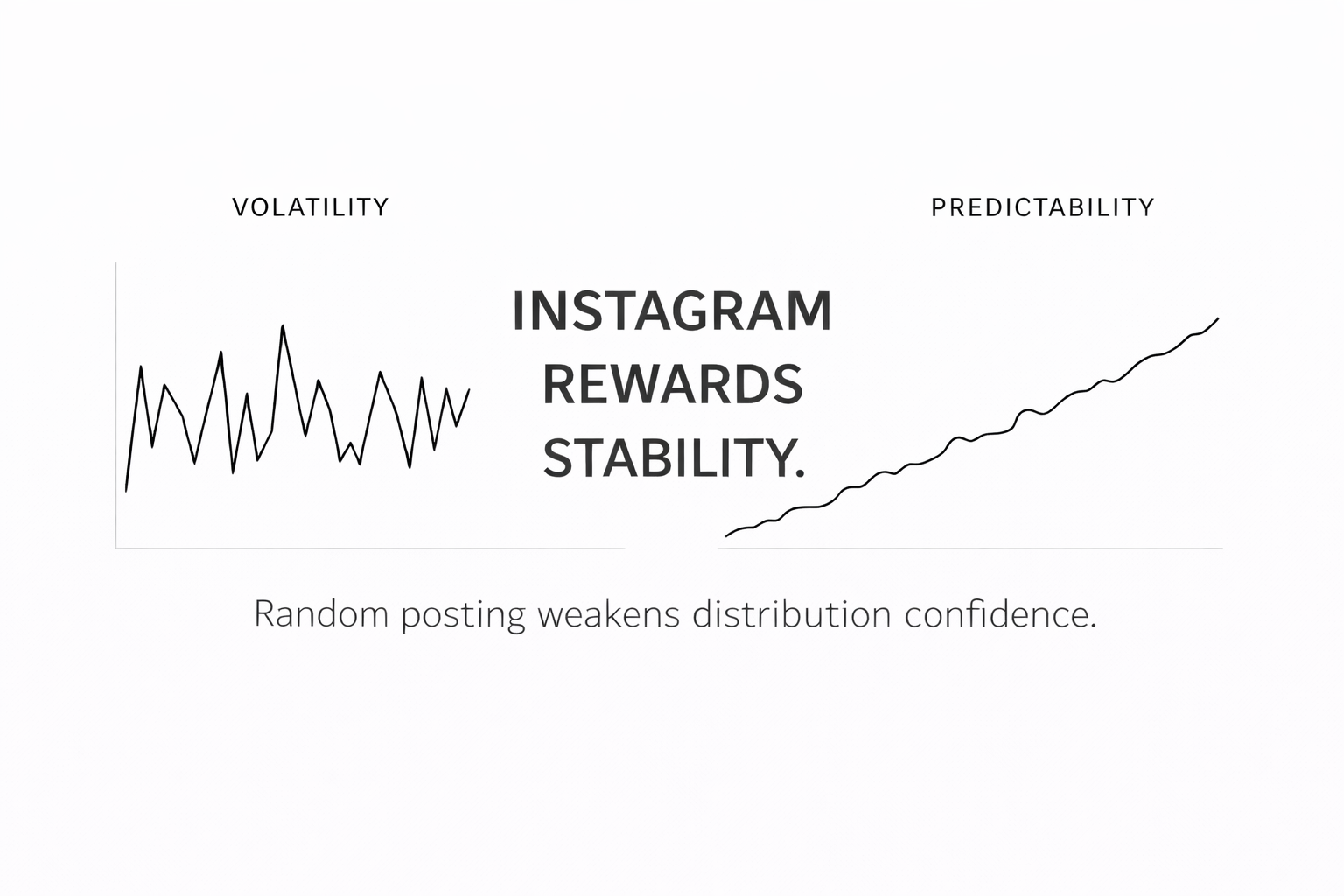
Instagram doesn’t scale chaos.
It scales predictability.
II. The Algorithm Is Pattern-Oriented
Instagram is not evaluating posts in isolation.
It evaluates patterns.
Your posting rhythm.
Your format stability.
Your content structure.
Your behavioral outcomes.
When you randomly switch between:
• Educational Reels
• Meme content
• Talking head videos
• Trend-based edits
• Long captions
• Short captions
without structural continuity…
you’re resetting your qualification cycle repeatedly.
Each post becomes a new experiment.
Each experiment restarts the trust clock.
That slows scale.
III. Randomness Weakens Structural Predictability
Growth systems operate on probability.
The more stable your behavioral signals are,
the easier it becomes for the platform to predict future performance.
Prediction drives distribution.
If your retention curve fluctuates wildly,
the system reduces exposure to control risk.
Because the platform optimizes for stability, not potential virality.
This is why some creators with “less impressive” content outperform more talented accounts.
Their structure is consistent.
Their signal pattern is predictable.
And predictable systems scale.
IV. The Stability Model
Sustainable growth requires three layers of consistency:
- Format Consistency
- Signal Consistency
- Posting Rhythm Consistency
Break one, scale slows.
Break two, scale fragments.
Break all three, growth feels random.
Unstable systems do not scale.
This is not creative advice.
It’s infrastructure logic.
At SMMRangers, when we analyze unstable accounts, we rarely see a creativity problem.
We see structural volatility.
Once volatility decreases, distribution normalizes.
Not magically.
Mechanically.
V. The Cost of Resetting Trust
Every inconsistent post forces the system to re-evaluate risk.
And risk evaluation consumes exposure inventory.
Inventory is limited.
So the platform allocates it to accounts with stable performance probability.
If you constantly change your structural behavior,
you never build statistical confidence.
And without confidence, expansion doesn’t trigger.
VI. Stability Is Not Boring
Some creators fear consistency.
They think repetition reduces creativity.
But structural stability does not mean creative stagnation.
It means predictable signal architecture.
You can innovate within a stable framework.
But if the framework collapses every week,
the system cannot model your performance.
And if it cannot model you,
it cannot scale you.
In Part 3, we move into the structural core of growth:
Retention Engineering.
Not engagement.
Not reach.
Retention.
Because distribution does not expand randomly.
It expands when attention stabilizes.
And before content scales,
it must first survive the first gate.