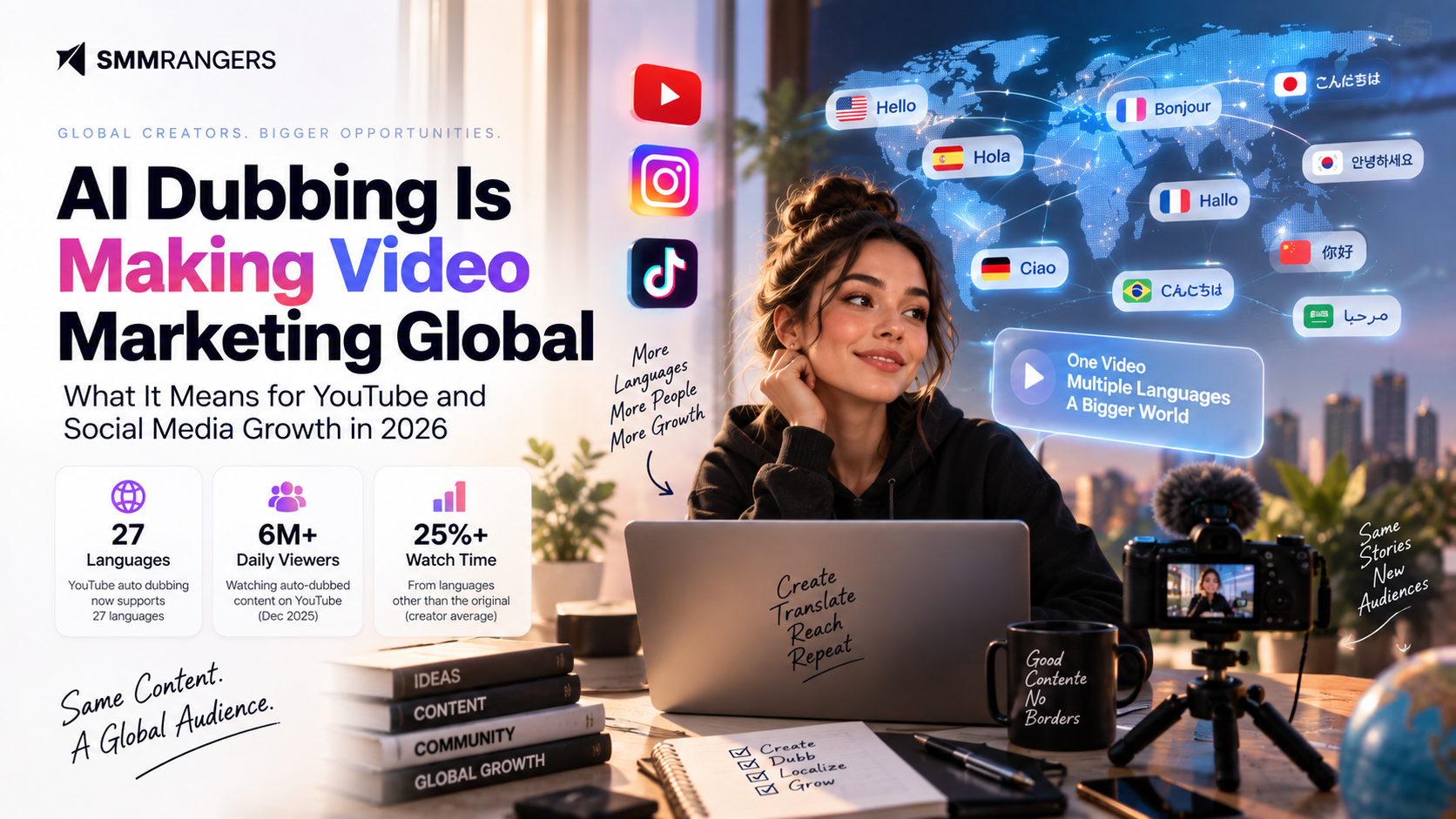
AI Dubbing Is Making Video Marketing Global: What It Means for YouTube and Social Media Growth in 2026
Short Answer: AI dubbing is turning language from a major distribution barrier into a manageable part of video marketing. In 2026, YouTube offers automatic dubbing across 27 languages, while Meta and TikTok are expanding AI-powered translation tools. For creators and marketers, one strong video can increasingly reach multiple language markets without being recreated from scratch.
Key Takeaways
YouTube made auto dubbing available to everyone in 2026 and expanded the feature to 27 languages.
More than 6 million YouTube viewers were watching at least 10 minutes of auto-dubbed content per day by December 2025.
YouTube creators using manually uploaded multi-language audio have seen more than 25% of their watch time come from non-primary languages on average.
Meta says hundreds of millions of people are watching AI-translated videos every day across its platforms.
TikTok's Symphony AI Dubbing also allows brands and creators to translate content into more than 10 languages and dialects.
Translation increases potential distribution, but localization, audience relevance and content quality still determine whether that reach becomes meaningful growth.
Video Is Becoming Language-Agnostic
For most of online video's history, language has defined the size of a creator's addressable audience.
An English-speaking creator could theoretically reach billions of people, but a viewer who did not understand English faced an obvious barrier.
Subtitles helped.
Professional dubbing helped more.
But both introduced friction.
Subtitles require viewers to read while watching. Professional dubbing requires translators, voice actors, editing and additional production costs.
AI is rapidly changing that equation.
In 2026, some of the world's largest social platforms are building translation directly into their video infrastructure.
YouTube can automatically generate alternative audio tracks.
Instagram and Facebook can translate, dub and even lip-sync Reels.
TikTok offers AI dubbing tools for creators and advertisers.
The result is an important shift in social media distribution:
Creators increasingly do not need to speak the language of every audience they want to reach.
That does not mean language no longer matters.
It means language is becoming something platforms can increasingly translate at the distribution layer.
YouTube Auto Dubbing Reached a Turning Point in 2026
YouTube's February 2026 update marked one of the clearest signs that AI dubbing is moving into the mainstream.
The company announced that auto dubbing was available to everyone and had expanded to 27 languages.
YouTube also revealed an important usage figure.
By December 2025, more than 6 million viewers per day were watching at least 10 minutes of automatically dubbed content.
This is not simply a feature sitting unused inside YouTube Studio.
There is already measurable viewer behavior around it.
YouTube's system takes the original spoken audio, translates it and generates alternative audio tracks. Viewers can select another language or indicate preferred languages for audio, titles and descriptions.
Creators can also review, unpublish or delete generated dubs.
For marketers, this creates something that previously required considerably more resources:
one video, multiple language markets.
The Watch-Time Data Shows Why This Matters
AI dubbing is relatively new, but YouTube's broader multi-language audio program provides useful evidence about the potential value of multilingual video.
In September 2025, YouTube reported that creators uploading multi-language audio tracks received, on average, more than 25% of their watch time from views in languages other than the video's primary language.
That is a significant number.
It suggests localization is not simply making existing viewers slightly more comfortable.
It can introduce content to audiences that may otherwise never have consumed it.
YouTube also highlighted individual examples.
Chef Jamie Oliver's channel saw views increase threefold after using multi-language audio tracks.
Creators such as MrBeast and Mark Rober have used multilingual audio extensively, with Mark Rober averaging more than 30 language tracks on some videos.
These examples should not be treated as guarantees. Large creators already have strong global demand and sophisticated content strategies.
But they demonstrate what becomes possible when language stops acting as a hard distribution boundary.
Auto Dubbing and Multi-Language Audio Are Not the Same Thing
There is an important distinction marketers should understand.
YouTube currently offers both automatic dubbing and multi-language audio.
Automatic dubbing uses YouTube's technology to generate translated audio tracks.
Multi-language audio allows creators to upload their own professionally recorded or externally produced dubs.
The strategic trade-off is straightforward.
Automatic dubbing dramatically lowers the cost and effort required to test new language markets.
Professional dubbing gives creators more control over translation, voice quality, cultural adaptation and brand tone.
That suggests a useful growth model:
Use AI dubbing to discover demand. Invest in deeper localization where demand appears.
Instead of professionally translating every video into ten languages before knowing whether an audience exists, creators can increasingly test multilingual distribution first.
Performance data can then guide where additional investment makes sense.
AI Dubbing Is Becoming More Human
Translation accuracy is only one part of the problem.
A perfectly translated sentence can still sound unnatural if emotion, rhythm and personality disappear.
Platforms are working on that problem too.
YouTube introduced Expressive Speech for eight languages, designed to preserve more of a creator's original emotion and energy.
The company is also testing automatic lip synchronization that adjusts the speaker's lip movements to better match translated audio.
Meta is moving in a similar direction.
Its AI translation technology can preserve elements of a creator's voice and tone while translating Reels. Creators can also enable lip syncing so translated speech visually matches mouth movement more closely.
The goal is no longer simply:
Can AI translate this video?
It is becoming:
Can the translated version still feel like the same creator?
That distinction matters enormously for creator marketing.
Personality is part of the product.
Instagram and Facebook Are Building the Same Global Layer
YouTube is not alone.
Meta has been rapidly expanding AI-powered translation across Facebook and Instagram.
By January 2026, Meta said AI dubbing was available across nine languages and that hundreds of millions of people were watching AI-translated videos every day.
Meta also said translated videos were already contributing incremental time spent on Instagram.
The company continued expanding language support during 2026.
On Facebook alone, Meta reported in June that more than half a billion users were watching AI-translated videos weekly.
Instagram has also expanded AI-powered Reels translation into additional languages, including French, German, Italian, Japanese and Korean.
The strategic implication is difficult to miss.
Platforms increasingly view translation as part of recommendation and distribution infrastructure rather than a separate production task.
A creator in one country can potentially create locally and distribute globally.
TikTok Is Building AI Dubbing for Marketers Too
TikTok has approached the opportunity from a more explicitly commercial direction.
Its Symphony AI Dubbing tool was designed for creators and brands that want to translate existing video into multiple languages.
TikTok says the tool can automatically detect the video's original language, transcribe it, translate it and generate dubbed versions.
It supports more than 10 languages and dialects.
For advertisers and agencies, this could significantly change creative localization.
Traditionally, entering five language markets could mean producing multiple versions of the same campaign.
AI dubbing makes another workflow possible:
produce once → translate → test markets → localize winners
That could reduce the cost of international creative experimentation.
But it also introduces a new challenge.
Making a video understandable does not automatically make it culturally relevant.
Translation Is Not Localization
This may be the most important distinction in the entire AI dubbing conversation.
Translation answers:
“What does this person say?”
Localization asks:
“Does this content make sense to this audience?”
Those are different problems.
Humor may not translate.
Cultural references may disappear.
Calls to action may feel unnatural.
Products may have different demand across countries.
Pricing expectations can change.
Even editing styles and thumbnail preferences can vary by market.
AI dubbing solves part of international distribution.
It does not solve international marketing.
Creators and brands should therefore avoid assuming:
translated = localized.
A Spanish dub may make an English video understandable to a Spanish-speaking viewer.
Whether that viewer cares about the video is still a content and audience problem.
What Should Marketers Do Now?
AI dubbing creates opportunities, but the strongest strategy is not simply enabling every available language.
1. Start With Existing Audience Data
Look at where your current international viewers already come from.
YouTube Analytics, for example, can reveal geographic demand and performance by audio track.
If a meaningful audience already exists in Brazil, Mexico, Germany or Japan, localization may have a clearer starting point.
2. Test Before Building Separate Channels
Historically, creators sometimes launched separate channels for each language.
That can work, but it also divides subscribers, analytics and content management.
Multi-language audio creates another option: keeping multiple language audiences around the same core video.
Test whether this model works before creating additional channels.
3. Localize Metadata Too
Audio is only part of discovery.
Titles, descriptions, captions and potentially thumbnails should also make sense for the target market.
A translated video cannot reach its full potential if users never understand why they should click it.
4. Review Important Dubs
AI translation can make mistakes.
YouTube itself warns that automatic dubbing may struggle with accents, dialects, proper nouns, idioms, jargon and background noise.
For high-value campaigns, product claims or technical content, human review remains valuable.
5. Measure by Language
Do not simply look at total views after enabling dubbing.
Compare:
watch time by language,
retention,
engagement,
subscriber conversion,
geography,
click-through rate,
traffic sources,
and business outcomes where available.
A language generating large view counts but weak retention may be less valuable than a smaller market with strong engagement.
6. Treat Localization as an Experiment
You do not need to translate everything immediately.
Start with evergreen videos or historically strong performers.
Identify which markets respond.
Then expand.
What AI Dubbing Means for Social Media Growth
AI dubbing changes one of the basic assumptions behind audience growth.
Historically, creators often thought about their potential audience geographically:
my country → my language → my audience.
Increasingly, platforms can separate those concepts.
A creator may produce content in Türkiye, record it in Turkish and eventually find viewers in English-speaking markets through translated audio.
An American creator may discover meaningful demand in Brazil.
A Spanish-speaking creator may find an English-speaking audience.
The addressable audience of a piece of content becomes larger.
But this creates another important distinction:
potential reach is not the same as meaningful growth.
Translation may open the door.
Content quality determines whether viewers stay.
Audience relevance determines whether they care.
Retention determines whether the platform continues distributing the video.
Trust determines whether viewers return.
And a coherent growth strategy determines whether temporary exposure becomes an audience.
What This Means for the SMM Industry
For social media marketers, agencies and resellers, multilingual distribution adds another dimension to campaign planning.
Growth can no longer be evaluated only by platform and quantity.
Geography and language increasingly matter too.
A campaign targeting YouTube viewers in Brazil may require a different content and distribution strategy from one targeting Germany or the United States.
The same principle applies when evaluating social media growth services.
Platforms such as SMMRangers can form one part of a broader growth toolkit, but the most useful service depends on the actual campaign objective.
That means marketers should think beyond questions such as:
“How many views can I get?”
and ask:
Which platform? Which market? Which language? Which audience? What happens after the view?
As video becomes easier to globalize, audience relevance becomes more important rather than less.
Raw numbers without context tell only part of the story.
One Video Can Now Become a Global Asset
AI dubbing could also change how marketers think about the economics of content production.
Consider a high-quality educational video.
Previously, the video might have been created primarily for one language market.
Reaching five additional markets could require separate scripts, voice talent, editing and production workflows.
Now the original asset can potentially become the foundation for multiple localized versions.
That increases the possible return on a strong piece of content.
Instead of:
create more videos
the better strategy may sometimes become:
extract more distribution from your best videos.
This is particularly relevant for evergreen content.
Tutorials, educational videos, product explainers, reviews and how-to content can continue attracting viewers long after publication.
Adding additional languages can potentially extend the useful life and addressable audience of those assets.
AI Dubbing Will Not Make Every Creator Global
There is a temptation with new technology to confuse capability with outcome.
AI dubbing makes global distribution easier.
It does not guarantee global demand.
A creator still needs:
content people want,
strong hooks,
audience relevance,
competitive packaging,
good retention,
consistent publishing,
and an understanding of the markets they are entering.
The same principle applies to almost every growth tool.
Technology can reduce friction.
It cannot manufacture genuine audience interest.
That is why the strongest international strategies will probably combine three layers:
translation + localization + distribution
Translation makes the content understandable.
Localization makes it relevant.
Distribution helps the right people discover it.
What Happens Next?
AI dubbing will likely become less visible over time.
That may sound counterintuitive.
Today, translated video still feels like a special feature.
But as translation quality improves, more languages become available and voice and lip synchronization become more natural, viewers may increasingly stop thinking about whether a video was originally produced in their language.
They may simply watch it.
That could have major consequences for creator competition.
Creators will increasingly compete not only against people speaking their language, but against relevant content from around the world.
At the same time, creators who once had access primarily to a local audience may gain opportunities to reach dramatically larger markets.
The internet already made publishing global.
AI dubbing is beginning to make understanding global too.
And for video marketers, that may become one of the most important distribution changes of the next few years.
Frequently Asked Questions
What is YouTube auto dubbing?
YouTube auto dubbing automatically translates a video's spoken audio and generates alternative language tracks. In 2026, YouTube expanded auto dubbing to 27 languages and made the feature broadly available.
Does YouTube auto dubbing help videos reach more viewers?
It can increase the potential audience because people who do not understand the original language can consume the video in another language. YouTube says auto dubbing does not negatively affect the original video's discovery, but additional reach is not guaranteed.
How many people watch auto-dubbed YouTube videos?
YouTube reported that, in December 2025, more than 6 million viewers per day watched at least 10 minutes of automatically dubbed content.
Is AI dubbing the same as localization?
No. Dubbing translates spoken content into another language. Localization also adapts elements such as cultural references, terminology, titles, thumbnails, offers and messaging for a particular market.
Does Instagram support AI dubbing?
Yes. Meta uses AI to translate and dub eligible Reels on Instagram and Facebook, with optional lip synchronization in supported markets and languages.
Can TikTok translate videos with AI?
TikTok's Symphony AI Dubbing is designed to translate and dub content for creators and marketers across more than 10 languages and dialects.
Build Global Growth Around the Audience, Not Just the Language
AI dubbing gives creators and marketers a powerful new distribution tool, but translation is only the beginning.
Successful international growth still requires the right content, audience, market and distribution strategy.
For marketers, agencies and resellers building campaigns across multiple platforms and regions, SMMRangers provides access to a broader range of social media growth services that can be considered alongside content localization and organic distribution.
As social media becomes more global, the question is no longer simply how large an audience you can reach.
It is which audience you are reaching — and whether your content gives them a reason to stay.