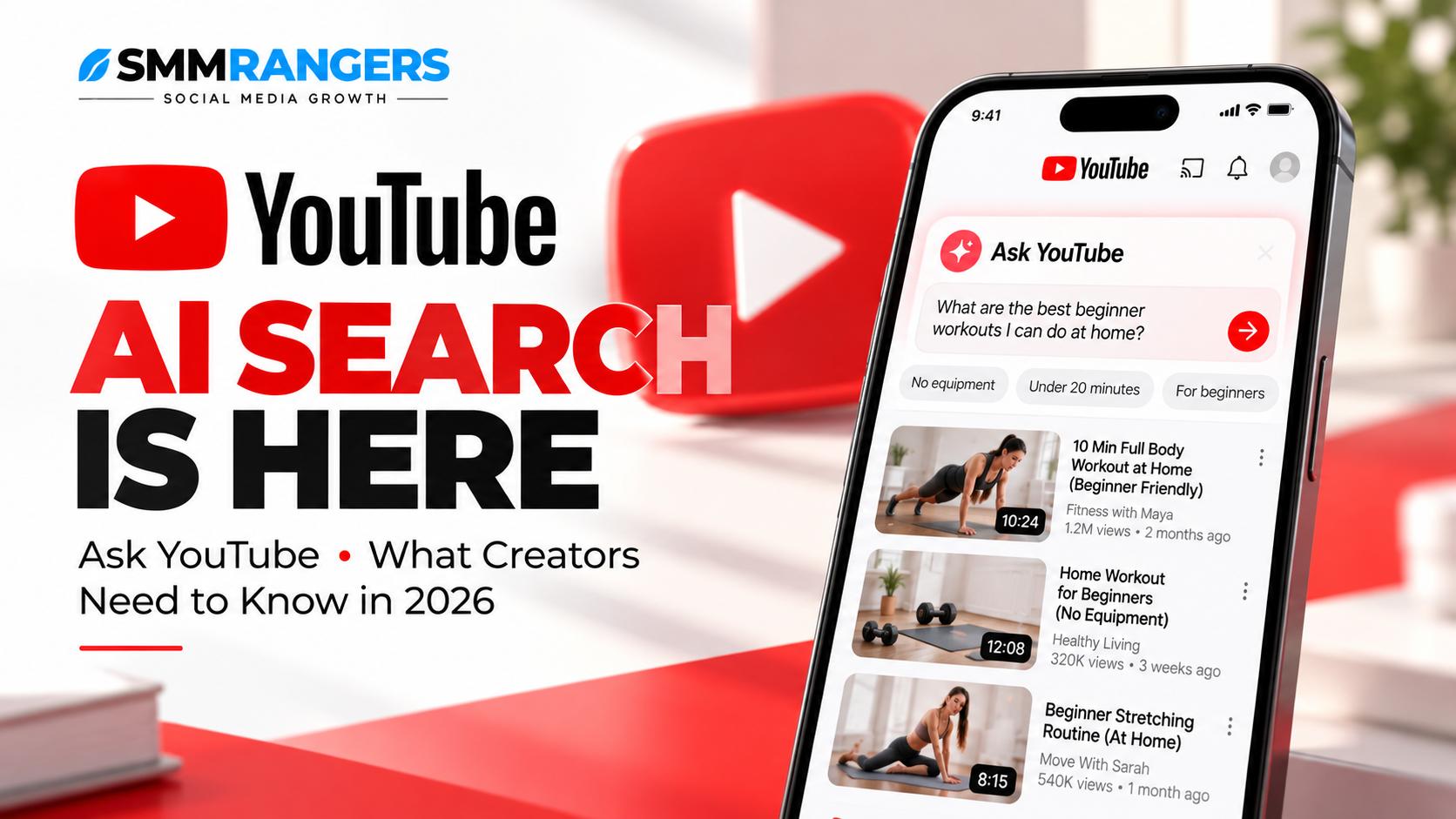
Ask YouTube AI Search 2026: How It Works and What Creators Need to Know
Updated October 13, 2026
YouTube search is becoming more conversational.
Instead of relying only on short keywords, viewers can now ask detailed questions, explore AI-generated answers, and discover relevant videos through follow-up conversations.
On October 12, 2026, YouTube announced an expansion of Ask YouTube to mobile devices, making its conversational search experience available to eligible viewers in the United States across web, mobile, and television devices.
For creators, brands, and digital marketers, this raises an important question:
How could AI-powered search change the way people discover videos on YouTube?
Let's explore what Ask YouTube does, how it works, and what it means for YouTube SEO and channel growth.
What Is Ask YouTube AI Search?
Ask YouTube is an AI-powered conversational search experience that helps viewers find videos by asking questions in natural language.
Traditional YouTube searches often involve a few keywords, such as:
Beginner home workouts
Best budget camera
How to edit YouTube Shorts
With Ask YouTube, viewers can make their requests more specific.
For example:
“What are some beginner-friendly home workouts that don't require equipment and take less than 20 minutes?”
Instead of simply displaying a conventional list of search results, Ask YouTube can generate an interactive response combining relevant videos, Shorts, video clips, and explanatory text.
Viewers can then ask follow-up questions to refine their results.
According to YouTube's official Help Center, Ask YouTube draws on YouTube content and real-time web information to help answer complex questions.
The goal is to make video discovery more useful, especially when viewers aren't sure which keywords to search for.
What's New With Ask YouTube in October 2026?
Ask YouTube was first introduced as part of YouTube's broader AI search experiments in 2026.
The October 12 announcement marks another important step in its expansion.
1. Ask YouTube expands across mobile devices
YouTube confirmed that Ask YouTube is available to eligible U.S. viewers on mobile, web, and TV.
This allows people to explore conversational search while using their phones rather than relying on a desktop computer.
2. Viewers can ask follow-up questions
Ask YouTube supports conversations rather than treating every search as an isolated request.
Someone researching a camera, for example, might begin with:
“Which cameras are best for beginner YouTubers?”
They could then ask:
“Which of those works best for filming indoors?”
This makes it easier to narrow down video recommendations without starting a completely new search.
3. Results can combine different content formats
Ask YouTube can present a combination of long-form videos, Shorts, relevant video segments, and text.
That means viewers may encounter creators through individual moments in their videos, not only through traditional search-result pages.
4. More viewing experiences are planned
YouTube has also announced plans to expand its Ask YouTube watch-page experience to Shorts and live streams.
These additions were described as upcoming features, so they should not be confused with capabilities already available to every user.
You can read the full announcement on the official YouTube Blog.
How to Use Ask YouTube on Mobile
For eligible users, the process is straightforward.
Open the YouTube mobile app.
Go to the search area.
Select the Ask option when it appears.
Enter a question in natural language.
Review the AI-generated response and suggested videos.
Ask a follow-up question if you want more specific results.
For example, a creator researching video production could ask:
“How can I improve lighting for YouTube videos using inexpensive equipment?”
They could then refine the request:
“Show me beginner tutorials for filming in a small room.”
This creates a more guided discovery experience than repeatedly entering different keyword combinations.
Is Ask YouTube available worldwide?
Not yet.
As of October 13, 2026, YouTube's official documentation lists availability for users searching in English in the United States on supported computer, mobile, and TV devices.
Availability is expanding gradually, and the feature may not appear on every account.
YouTube has not confirmed a general worldwide launch date.
Ask YouTube vs Traditional YouTube Search
Although both experiences help viewers find content, they approach discovery differently.
| Traditional YouTube Search | Ask YouTube AI Search |
|---|---|
| Often starts with keywords | Supports detailed natural-language questions |
| Displays conventional search results | Can generate conversational responses |
| Users manually refine searches | Users can ask follow-up questions |
| Emphasizes video result listings | Can combine videos, clips, Shorts, and text |
| Familiar search interface | Interactive AI-assisted discovery |
Importantly, Ask YouTube complements traditional search rather than replacing it.
Creators should not abandon established YouTube SEO practices simply because conversational search is expanding.
Does Ask YouTube Change YouTube SEO?
Potentially, but not in the way some marketers might expect.
YouTube has introduced a new way for viewers to discover content. However, it has not published a new ranking formula specifically explaining how creators can optimize videos for Ask YouTube.
There is currently no verified shortcut for appearing in its AI-generated responses.
Still, the development suggests several practical areas creators should consider.
1. Create videos that answer specific questions
Conversational searches are often more detailed than traditional keyword queries.
Instead of producing a general video titled:
YouTube Camera Tips
A creator might publish:
How to Choose Your First YouTube Camera on a $300 Budget
The second topic addresses a more specific viewer need.
That doesn't guarantee inclusion in Ask YouTube, but it can make the content more useful to people searching for that answer.
2. Make titles and descriptions clear
Video titles should accurately describe the subject.
Descriptions can provide additional context, including the questions addressed and topics covered.
Avoid misleading titles, repetitive keyword stuffing, or descriptions that promise information the video doesn't contain.
3. Organize educational videos clearly
Tutorials, comparisons, and explanatory videos often benefit from a logical structure.
Creators can use clear introductions, descriptive chapters where appropriate, and understandable explanations.
These practices improve the viewing experience regardless of whether someone discovers the video through AI search or traditional recommendations.
4. Focus on genuine viewer satisfaction
A successful video should deliver on the promise made by its title and thumbnail.
Audience retention, relevance, and viewer satisfaction remain important considerations in a broader YouTube strategy.
However, creators should not assume that any single engagement metric determines Ask YouTube visibility.
5. Monitor performance instead of guessing
Use YouTube Analytics to examine:
Traffic sources
Search queries where available
Audience retention
Click-through rates
Returning viewers
Subscriber growth
YouTube has not announced a dedicated Ask YouTube ranking dashboard for creators.
Until more information becomes available, analyzing existing performance data is more useful than claiming to know how the new AI system ranks videos.
What Does Ask YouTube Mean for Small Creators?
One of the most interesting possibilities is more specific content discovery.
Consider two channels.
The first publishes general fitness videos.
The second focuses on short home workouts for beginners who have limited time and no equipment.
A conversational search experience could help viewers express the second type of need more precisely.
This creates a potential opportunity for creators who publish helpful content for clearly defined audiences.
But it is important to distinguish an opportunity from a guarantee.
YouTube has not confirmed that Ask YouTube automatically favors small channels, niche creators, or any particular video format.
The practical takeaway is to understand your audience's questions and create content that answers them well.
Do YouTube Subscribers, Likes, and Views Affect Ask YouTube Results?
This is an important distinction for creators and social media marketers.
YouTube subscribers, likes, and views are visible engagement metrics. They can help creators understand different aspects of channel activity and audience response.
But there is no verified evidence that purchasing subscribers, likes, or views improves placement in Ask YouTube AI Search.
YouTube has not announced a special AI-search ranking benefit for purchased engagement.
It is also important to distinguish between:
Organic video discovery: Viewers finding content through YouTube search, recommendations, subscriptions, and other platform experiences.
Official YouTube advertising: Paid campaigns managed through Google's advertising systems.
Third-party SMM services: Services offering specific social media metrics or promotional activities, subject to their individual conditions and platform rules.
These methods are not interchangeable.
Artificial engagement may also violate platform policies and can result in invalid engagement being removed or other account consequences.
Creators should evaluate promotional services carefully rather than treating visible numbers as proof of genuine audience interest.
For a broader introduction to these services, read our guide to what an SMM panel is.
What Does AI Search Mean for SMM Panel Customers?
For SMM panel customers and resellers, the most useful lesson is to separate visibility metrics from content discoverability.
A service offering YouTube views is not automatically a YouTube SEO service.
Likewise, a subscriber service should not be presented as a guaranteed way to appear in AI-generated search results.
Before choosing any third-party service, customers should understand:
What the service actually delivers
Its minimum and maximum order quantities
Expected delivery speed
Whether refill or cancellation is available
Possible drops and limitations
Relevant platform-policy risks
At SMMRangers, customers can explore available YouTube-related services and review their individual descriptions and conditions.
Our YouTube views guide also provides additional context for people researching video-view services.
The goal should be to make informed decisions, not to assume that purchased metrics guarantee organic reach, monetization, or AI search placement.
How Creators Can Prepare for AI-Powered Video Discovery
Ask YouTube is still evolving, but creators don't need to wait for a new ranking formula to improve their content.
Here is a practical starting checklist.
Understand what your audience wants to know
Identify the questions people regularly ask about your niche.
Customer support conversations, YouTube comments, search suggestions, and community discussions can all reveal useful content ideas.
Publish genuinely helpful answers
Build videos around specific problems.
A complete and accurate answer is more valuable to viewers than a vague video created solely around a popular keyword.
Improve your existing video library
Review older tutorials, update outdated descriptions where necessary, and make titles more accurate.
If a topic has changed substantially, consider publishing an updated video.
Use Shorts and long-form content strategically
Ask YouTube can surface different video formats.
Use each format where it best serves the topic rather than assuming one is universally preferred by AI search.
Stay informed about official changes
AI search features can evolve quickly.
Follow the YouTube Blog and YouTube Help Center for verified updates.
Avoid strategies based on unconfirmed algorithm claims.
Frequently Asked Questions
What is Ask YouTube?
Ask YouTube is an AI-powered conversational search experience that helps users discover videos by asking questions and refining results through follow-up prompts.
Is Ask YouTube free?
YouTube's current help documentation describes availability for eligible users in the United States without listing a general Premium-only requirement. Access still depends on rollout eligibility and supported devices.
Is Ask YouTube available on Android and iPhone?
YouTube has expanded the experience to supported mobile devices. Availability depends on account eligibility, language, and region.
Can Ask YouTube recommend Shorts?
Yes. Its search responses can include Shorts alongside long-form videos, text, and relevant video clips.
Does Ask YouTube replace the YouTube algorithm?
No. Ask YouTube is an additional discovery experience. YouTube has not announced that it replaces the platform's existing search and recommendation systems.
Can buying YouTube views improve Ask YouTube rankings?
There is no verified evidence that purchased views improve Ask YouTube placement. Buying artificial engagement may also create platform-policy risks.
Will Ask YouTube change how creators grow their channels?
It may create additional discovery opportunities, but its long-term impact is not yet established. Useful content, clear topics, and audience understanding remain sensible priorities.
Final Thoughts: YouTube Search Is Becoming More Conversational
Ask YouTube represents an important development in how viewers explore video content.
Its October 2026 mobile expansion brings conversational discovery to more viewing situations and allows users to search with detailed questions rather than relying only on keywords.
For creators, the best response is not to chase unverified AI ranking tricks.
Instead, focus on answering real audience questions, producing valuable videos, and monitoring performance as YouTube publishes more information.
For marketers and SMM panel customers, the same principle applies: understand the difference between video discovery, advertising, and engagement metrics.
As AI-powered search continues to develop, informed decisions will matter more than exaggerated promises.
Explore SMMRangers for YouTube-related service information, or browse our SMM panel beginner's guide to learn more about how these services work.