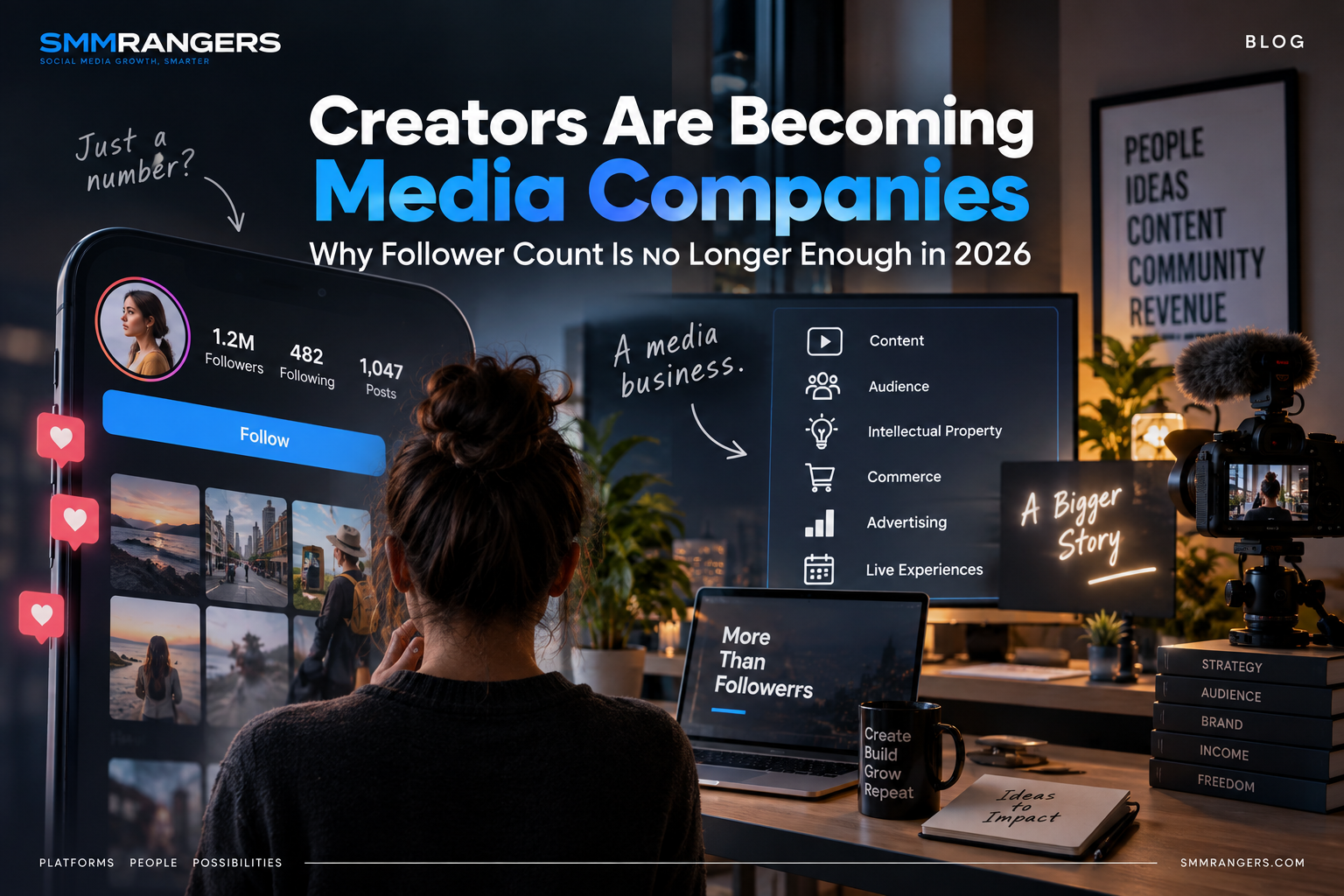
Creators Are Becoming Media Companies: Why Follower Count Is No Longer Enough in 2026
Creators are no longer competing only with other influencers for attention. The most sophisticated creator businesses are beginning to operate more like media companies—building recurring shows, intellectual property, commerce, live experiences and long-term advertising partnerships. As that happens, follower count remains useful context, but it is becoming an increasingly incomplete measure of creator value.
Short Answer
The creator economy is evolving from one-off sponsored posts toward full media businesses built around content, audiences, intellectual property and commerce. For marketers, this means follower count alone is no longer enough to evaluate influence. Audience relevance, actual reach, engagement quality, retention and measurable business outcomes increasingly matter alongside scale.
Key Takeaways
Creator advertising is becoming a standalone media channel rather than simply a social media tactic.
IAB projected U.S. creator ad spend to reach approximately $44 billion in 2026.
Some creator businesses are beginning to pitch advertisers using models traditionally associated with TV networks and publishers.
Follower count still matters, but it does not reliably tell marketers how many people actually see, trust or act on a creator's content.
Audience fit, actual distribution, engagement quality and business outcomes provide a more complete picture of creator value.
For social media growth, bigger numbers are most useful when they are connected to relevant audiences, credible engagement and a clear objective.
Creators Are Starting to Look Like Media Companies
For years, influencer marketing followed a relatively simple model.
A creator built an audience. A brand looked at the creator's follower count and engagement rate. The two agreed on a sponsored post, Reel or video.
That model still exists, but the creator economy around it is becoming considerably more sophisticated.
A revealing example emerged in Europe in September 2026.
Arcade, the entertainment company working with creators including the Sidemen, Max Fosh and other creator-led brands, hosted what it described as Europe's first creator media Upfront in London.
The format matters.
Upfronts have traditionally been associated with television networks presenting upcoming programming and advertising opportunities to major advertisers. Arcade's event instead presented creator content slates, audience data and commercial opportunities to more than 150 advertisers, brands and partners.
Creators were effectively being presented as media properties rather than simply social accounts.
The development is part of a broader change already visible across the creator economy.
YouTube CEO Neal Mohan described creators in 2026 as people building the “media companies of the future.” YouTube itself has expanded creator partnership infrastructure, commerce tools and advertising integrations designed to make creator businesses easier for advertisers to discover, evaluate and measure.
The distinction is important.
An influencer primarily monetizes influence.
A creator-led media business can monetize an entire ecosystem.
That may include:
advertising,
sponsorships,
subscriptions,
affiliate commerce,
merchandise,
intellectual property,
live events,
licensing,
long-form programming,
short-form distribution,
and direct relationships with its audience.
The social account becomes the distribution layer for something much larger.
The Money Is Following the Shift
This transformation is not happening only at the top of the creator market.
Advertising investment is moving in the same direction.
The Interactive Advertising Bureau projected U.S. creator advertising spending to reach approximately $44 billion in 2026, after estimating $37 billion in 2025.
IAB's research also found that nearly half of creator ad buyers already considered creators a “must buy.”
That language is significant.
Creator marketing is increasingly being treated as its own media channel rather than an experimental subsection of social media marketing.
At the same time, digital video continues to expand. IAB expects U.S. digital video advertising spending to surpass $80 billion in 2026, with social video among the forces driving that growth.
Brands therefore face a more complicated question than they did during the early influencer era.
It is no longer simply:
How many followers does this person have?
It is:
What kind of media asset has this creator built, who actually consumes it, and what happens when that audience pays attention?
That requires better measurement.
Why Follower Count Is No Longer Enough
Follower count is easy to understand.
A creator with 2 million followers appears larger than one with 200,000.
But theoretical audience size and actual distribution are not the same thing.
Modern recommendation systems on platforms such as Instagram, TikTok and YouTube routinely distribute content beyond followers while simultaneously showing only a portion of a creator's followers any individual piece of content.
Someone does not necessarily need to follow a creator to encounter their content.
And following a creator does not guarantee seeing every post.
That changes the meaning of the follower number.
Recent research from Sprout Social illustrates the gap. In its 2026 influencer marketing research, only 17% of surveyed consumers said they check a creator's follower count before deciding whether to engage with their content. Topic relevance and content style played larger roles.
CreatorIQ's 2026 State of Creators study adds an interesting contradiction.
Its research, based on more than 5,000 creators across 100 regions, found that brands say they value qualities such as relevance and engagement, yet creator earnings still correlate strongly with follower and view counts.
In other words, the industry intellectually understands that follower count is incomplete—but parts of its economics still reward scale.
That tension is likely to define the next stage of creator marketing.
Follower count is not useless.
It is simply one signal among many.
A Better Way to Evaluate Creator Value
If follower count cannot answer the entire question, what should marketers measure instead?
A useful framework contains four layers.
1. Audience Relevance
Start with who the creator actually reaches.
Consider:
geography,
language,
age and demographics where appropriate,
audience interests,
brand-category relevance,
audience authenticity,
and overlap with the campaign's intended customer.
A creator can have an enormous audience and still be a poor match for a particular business.
Conversely, a smaller creator with concentrated relevance may offer far more useful distribution.
2. Actual Distribution
Followers represent potential audience.
Reach and views reveal more about realized distribution.
Marketers should examine metrics such as:
median views,
typical reach,
consistency across posts,
performance trends,
performance by content format,
and differences between organic and sponsored content.
Median performance can be particularly useful because a small number of viral posts can distort averages.
The central question is simple:
How many people normally see this creator's content?
That can be considerably more informative than the number displayed beside the Follow button.
3. Quality of Attention
A view tells you that content reached a screen.
It does not necessarily tell you whether the audience cared.
That is where engagement quality becomes important.
Likes can provide useful information, but marketers should also examine:
shares,
saves,
meaningful comments,
reposts,
watch time,
completion rate,
repeat viewing,
profile actions,
and other signals appropriate to the platform.
Different interactions represent different forms of attention.
A share can indicate that content was valuable enough to distribute to someone else. A save may indicate future utility. A detailed comment can reveal a very different level of involvement from a generic reaction.
There is no universal “best engagement metric.”
The correct metric depends on what the campaign is trying to accomplish.
4. Business Impact
Eventually, attention needs to connect to an objective.
Depending on the campaign, that could mean:
website visits,
sign-ups,
purchases,
affiliate sales,
app installs,
qualified leads,
brand lift,
search interest,
or another measurable outcome.
A creator campaign designed for awareness should not be evaluated exactly like an affiliate campaign designed for immediate sales.
Measurement needs to begin with the objective—not with whichever number happens to look largest.
From Influencer Campaigns to Creator Partnerships
Another major shift is the move from transactional campaigns toward longer relationships.
Northwestern University's Medill Spiegel Research Center reported in its 2026 creator marketing research that 91% of surveyed brands using creator marketing had an always-on component in their programs.
Only 9% remained primarily campaign-based.
That suggests creator marketing is becoming infrastructure rather than an occasional activation.
YouTube is moving in the same direction.
Its Creator Partnerships platform integrates creator discovery and partnership capabilities into YouTube Studio, Google Ads and Display & Video 360. YouTube says advertisers can access more than 3 million creators in the YouTube Partner Program through its broader ecosystem.
The underlying idea is straightforward.
Brands increasingly want to identify creators, understand their audiences, activate partnerships and measure results systematically.
That resembles media buying far more than the informal influencer outreach model of a few years ago.
What This Means for Social Media Growth
The same shift has consequences beyond influencer marketing.
It changes how we should think about social media growth itself.
A useful way to frame growth is:
Content quality × audience relevance × distribution × engagement quality × retention
None of those factors completely replaces the others.
Excellent content with almost no distribution can struggle to find an audience.
Large distribution directed toward the wrong audience can produce impressive numbers without meaningful results.
A large audience that never returns creates weak long-term value.
And engagement without relevance may generate activity without moving the creator or business toward its actual objective.
This is why raw numbers should be interpreted rather than simply collected.
Ten thousand followers can represent very different things.
Ten thousand followers in the right market who regularly consume the content are different from ten thousand largely inactive accounts.
One hundred thousand video views with strong retention and sharing can tell a different story from one hundred thousand brief impressions.
The number is the starting point of the analysis—not the conclusion.
What Should Marketers and Creators Do Now?
Define the objective before choosing the metric
Do not start with “we need more followers.”
Start with what you actually want to accomplish.
Is the goal awareness, social proof, community growth, video distribution, traffic, sales or creator monetization?
The answer determines which metrics matter.
Measure actual reach, not just theoretical audience
Compare follower count with median reach and views.
A large gap between audience size and normal distribution can reveal information that follower count alone hides.
Look at engagement quality
Do not reduce engagement to a single percentage.
Examine what people actually do with the content: watch, save, share, comment, click or return.
Evaluate audience fit
For creator partnerships, ask whether the audience matches the market you need to reach.
Audience relevance often matters more than maximum possible scale.
Separate growth tools from content strategy
Distribution can help content reach more people.
It cannot automatically make weak content interesting, improve audience-product fit or create long-term loyalty.
Creators, agencies and social media marketers should treat growth services as one component of a broader strategy rather than a substitute for one.
Build assets, not only numbers
The creators becoming media companies are not simply accumulating followers.
They are building reusable assets:
audiences, formats, intellectual property, recurring shows, communities, commerce systems and advertiser relationships.
Those assets can survive individual posts—and sometimes individual platforms.
What This Means for the SMM Industry
The same distinction between quantity and quality is increasingly relevant to the SMM market.
Historically, social media services have often been compared primarily by quantity and price:
How many followers?
How many views?
How many likes?
How much per thousand?
Those numbers still matter operationally. But professional marketers, agencies and resellers increasingly need additional questions.
How reliable is delivery?
How well does the service match the campaign objective?
What happens to retention?
Is refill available when relevant?
How consistent is the service?
Which platform, market and audience is the campaign trying to reach?
What happens after the initial visibility?
This is also a useful way to think about platforms such as SMMRangers.
Social media growth services can form one part of a larger toolkit used by marketers, agencies and resellers. But service volume should not be confused with an entire growth strategy.
Content, distribution, audience relevance, retention and measurement still need to work together.
As creator marketing becomes more professional, expectations around social media services are likely to become more professional as well.
The future of the SMM industry may therefore be less about selling the largest possible number and more about helping customers understand which services fit which objectives—and how to evaluate their performance.
What Happens Next?
The creator economy appears to be moving toward something traditional media understands very well: packaging audiences, programming and advertising opportunities into predictable media products.
But creators have one major advantage.
They often combine production, personality, distribution, community and commerce within the same ecosystem.
Platforms are responding by building infrastructure around that relationship. Advertisers are developing more sophisticated measurement. Creator businesses are expanding beyond individual posts.
And audiences increasingly discover content through recommendation systems rather than only through accounts they deliberately follow.
All of this makes one familiar metric less capable of explaining the entire picture.
Follower count will not disappear.
It remains useful evidence of scale, cultural visibility and accumulated audience.
But in 2026, the more valuable question is no longer simply:
How many people follow you?
It is:
Who pays attention—and what happens when they do?
Frequently Asked Questions
Are follower counts still important in 2026?
Yes, but follower count should be treated as one signal rather than a complete measure of influence. Actual reach, audience relevance, engagement quality, retention and campaign outcomes provide important additional context.
Why are creators becoming media companies?
Successful creators increasingly operate across multiple revenue and content streams, including advertising, sponsorships, commerce, subscriptions, live events and intellectual property. Some creator businesses are also developing recurring programming and structured advertising opportunities similar to traditional media companies.
What metrics should brands use to evaluate creators?
Useful metrics include audience fit, median reach and views, engagement quality, shares, saves, watch time, sponsored-content performance and campaign-specific business outcomes such as traffic, conversions or sales.
Are micro-influencers better than large creators?
Not automatically. Creator size alone does not determine campaign performance. The better choice depends on audience relevance, actual distribution, content quality, campaign objective and cost.
What is engagement quality?
Engagement quality looks beyond the number of interactions to consider what those interactions represent. Shares, saves, meaningful comments, watch time and actions after viewing can provide more context than likes alone.
What does the creator economy shift mean for social media growth?
It makes audience quality and measurable attention more important. Sustainable social growth increasingly depends on combining good content with relevant distribution, meaningful engagement and audience retention rather than optimizing a single headline number.
Build Growth Around the Metrics That Matter
Social media growth is becoming more sophisticated—and the tools used to support it should be evaluated the same way.
For marketers, agencies and resellers exploring social media growth services across multiple platforms, SMMRangers provides a broader service marketplace to compare options based on the needs of each campaign.
The goal should not simply be a bigger number. It should be understanding what that number is supposed to achieve.