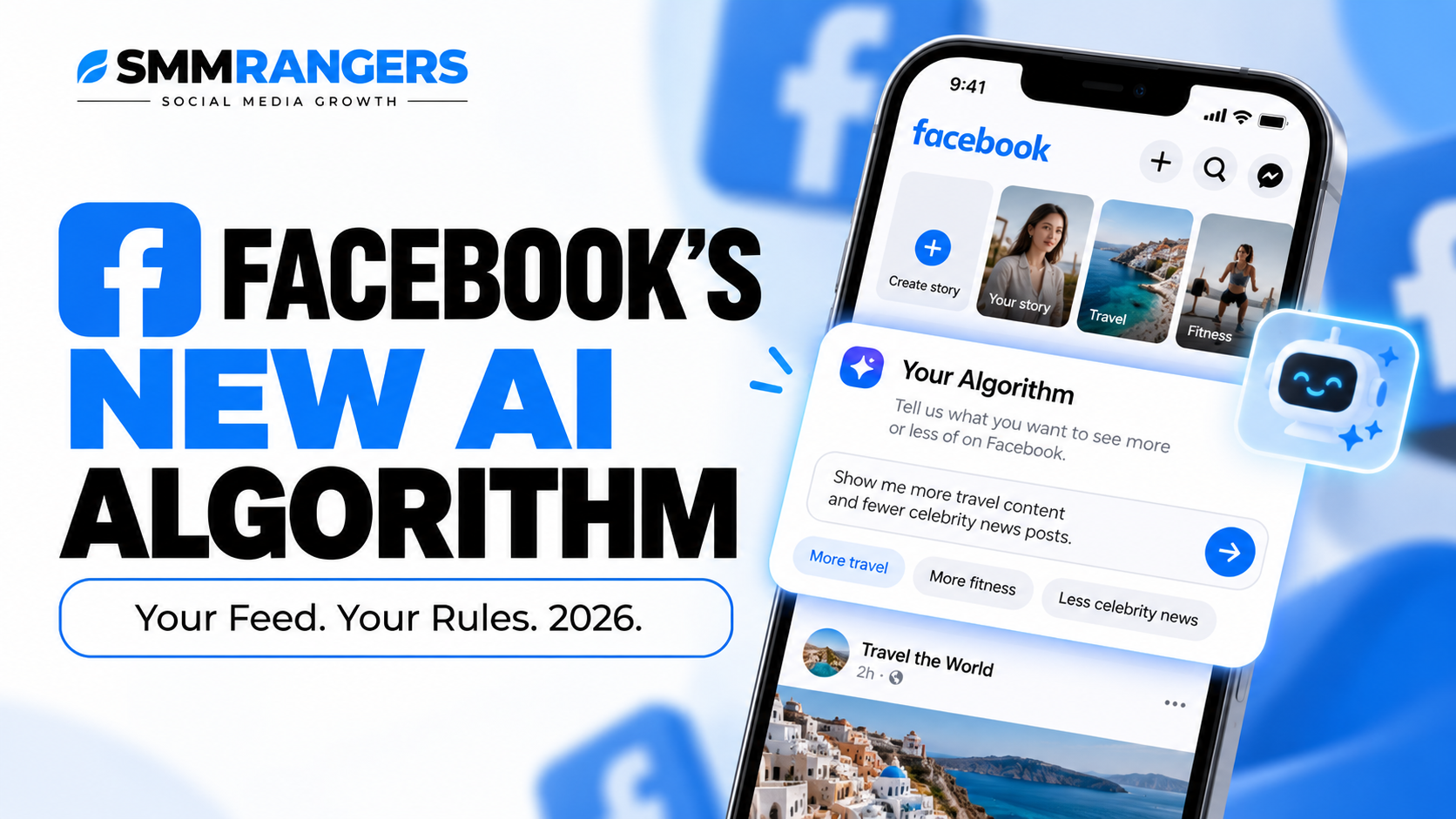
Facebook's New AI Algorithm in 2026: How Your Algorithm Changes What You See
Updated October 14, 2026 | Facebook News & Creator Guide
Facebook is changing the way people control what appears in their feeds.
On October 13, 2026, Meta announced new AI-powered personalization tools for Facebook, introducing a more conversational way to influence recommendations across Feed and Reels.
The update centers on a feature called Your Algorithm, which allows users to describe the topics they want to see more or less often using everyday language.
Instead of relying entirely on Facebook to infer your interests from likes, comments, and viewing habits, you can now communicate your preferences more directly.
But what does this mean for creators, businesses, and social media marketers?
And do Facebook likes, reactions, and video views still matter?
Let's take a closer look.
What Is Facebook's New AI Algorithm Update?
Facebook's October 2026 update introduces new ways for users to influence their content recommendations.
The most important addition is Your Algorithm, an AI-powered feature that lets people manage the topics they want to see in their Facebook Feed and Reels.
For example, someone interested in fitness could tell Facebook:
“Show me more beginner workout videos and fewer celebrity news posts.”
Facebook can then use that information to refine the content it recommends.
According to Meta, its recommendation systems can respond to these preferences within the same browsing session.
This is different from traditional personalization, where Facebook primarily infers interests from user behavior.
The new system adds explicit, written feedback alongside existing signals.
Important: This is not a complete replacement for Facebook's recommendation algorithm. It is an additional way to personalize an existing system.
What Is the Facebook Your Algorithm Feature?
Your Algorithm is a dedicated area where users can review and manage the topics influencing their recommendations.
Meta says the feature is accessible through the three-dot menu associated with Facebook posts.
Users can add or adjust their interests to help shape what appears in Feed and Reels.
The goal is to give people more direct control over their experience.
How is this different from the old Facebook algorithm?
Facebook has long used signals such as:
Posts you like
Comments you leave
Videos you watch
Content you interact with
Other behavioral and contextual information
These signals help the platform estimate which posts may be relevant to you.
The October update introduces another source of information: what users explicitly say they want to see.
Rather than relying only on behavioral predictions, Facebook can interpret natural-language preferences and incorporate them into recommendations.
Meta says large language models help its systems understand the context and intent behind these requests.
How to Change Your Facebook Algorithm in 2026
If Your Algorithm is available on your account, you can try the following steps.
Step 1: Open Facebook
Open the Facebook app and navigate to your Feed or Reels.
Step 2: Find the three-dot menu
Look for the three-dot menu on a post.
Meta has updated this menu to make recommendation controls easier to access.
Step 3: Select Your Algorithm
If the feature appears, open Your Algorithm to review and manage your topic preferences.
Step 4: Describe your interests
Add topics you would like to see more frequently or indicate topics you would prefer to see less often.
For example:
“I want to see more travel photography, cooking tutorials, and small business advice.”
Step 5: Use Interested or Not Interested
You can also provide feedback directly on individual posts.
Facebook may ask follow-up questions to better understand what you liked or disliked.
Step 6: Review your recommendations
Meta says its system can adapt within the same session.
However, the exact results may vary depending on the content available and other recommendation signals.
Availability note: Meta is rolling out these tools, and it has not provided a complete country-by-country release schedule. If you cannot find Your Algorithm, it may not be available to your account yet.
For official information, visit Meta's announcement about Your Algorithm.
How Does AI Change Facebook Reels Recommendations?
Reels is one of the most interesting parts of this update.
Previously, Facebook could learn about your interests from videos you watched, liked, shared, or skipped.
Now, users can also describe the type of Reels they want to discover.
For example, a person could express interest in:
Home renovation tutorials
Beginner fitness videos
Travel recommendations
Cooking content
Technology reviews
This creates another way for Facebook to understand what viewers find relevant.
However, Meta has not disclosed exactly how much weight written preferences receive compared with watch time, likes, shares, or other signals.
Creators should therefore avoid treating this update as a completely new or fully understood ranking formula.
Why does this matter for content creators?
The update highlights the importance of producing content that matches a clearly defined audience's interests.
A creator making beginner-friendly cooking tutorials, for example, may benefit from understanding the specific questions and preferences of people interested in learning to cook.
That does not mean Facebook guarantees more exposure to niche creators.
It means the platform is giving viewers another way to communicate what they want to watch.
Do Facebook Likes, Comments, and Views Still Matter?
Yes. Facebook has not announced that likes, comments, or viewing behavior are being removed from its recommendation systems.
In its official October announcement, Meta specifically described these interactions as part of the information its systems already use to understand user interests.
What has changed is the addition of natural-language feedback.
Let's distinguish the different metrics.
| Metric | What It Represents |
|---|---|
| Likes | A visible positive reaction to content |
| Reactions | Different emotional responses to a post |
| Comments | Responses and conversations around content |
| Shares | Content distributed by users to others |
| Video views | Recorded video viewing activity under the applicable measurement rules |
| Written preferences | Topics or content types users explicitly want more or less of |
These signals do not all measure the same thing.
A post with many reactions does not necessarily satisfy the interests of every viewer.
Likewise, a video with high view counts is not automatically the best recommendation for a particular person.
Does buying Facebook likes improve the new algorithm?
There is no verified evidence that purchased likes, reactions, or views improve placement through Facebook's new Your Algorithm feature.
Meta has not announced a ranking advantage for third-party engagement purchases.
Artificial engagement may also violate platform policies and may be filtered or removed.
Creators should distinguish visible engagement metrics from authentic audience interest and genuine content discovery.
What Does the Facebook Algorithm Update Mean for Small Creators?
Small creators often wonder whether algorithm changes make it easier or harder to reach new audiences.
The October 2026 update does not establish a guaranteed advantage for accounts of any particular size.
However, it reinforces a useful content strategy: know who your content is for.
Consider a creator publishing general fitness content.
Instead of making every video about broad fitness trends, they might focus on specific audience needs:
Ten-minute workouts for beginners
Home exercises without equipment
Mobility routines for office workers
Simple stretching tutorials
These topics answer clear viewer interests.
That can make the content more useful regardless of how Facebook's recommendation system evolves.
The key is relevance, not simply increasing the number of visible interactions.
Five Practical Tips for Facebook Creators in 2026
1. Define your audience clearly
Think about the people you want to reach.
What questions do they ask? What problems do they want to solve? What type of content do they enjoy?
Use these answers to guide your content planning.
2. Create content around specific interests
Instead of trying to appeal to everyone, consider creating posts and Reels for clearly defined topics.
Specificity can make your content more useful to the intended audience.
3. Make your content easy to understand
Use accurate captions, clear descriptions, and straightforward video introductions.
Avoid misleading headlines or promises that the content does not fulfill.
4. Encourage meaningful conversations
Ask relevant questions and respond to genuine comments.
Focus on conversations that add value rather than repetitive or automated interactions.
5. Review performance over time
Use the analytics tools available to your account to evaluate how your content performs.
Look at reach, engagement, video performance, and audience response together.
Avoid drawing conclusions from one metric or one post.
What Does This Update Mean for Facebook Marketing?
For businesses and social media agencies, Your Algorithm introduces another consideration in content planning.
Users can now communicate their interests more directly, potentially making recommendations more responsive to changing preferences.
This strengthens the case for understanding the intended audience before publishing.
Businesses should consider:
Whether their content addresses relevant customer interests
Which types of posts encourage genuine engagement
Whether Reels are useful for their audience
How organic content supports broader marketing goals
Whether performance metrics reflect meaningful business outcomes
However, the announcement does not establish new advertiser targeting controls or prove that paid advertising performance will improve.
Facebook's organic recommendation tools and Meta's advertising systems should not be treated as identical.
Facebook Organic Reach vs. SMM Panel Services
For people exploring social media marketing, it is important to understand the difference between organic discovery and third-party engagement services.
Organic reach refers to content reaching people through Facebook's normal distribution and recommendation systems without paying for that particular exposure through an advertising campaign.
Meta Ads are official paid advertising tools that allow businesses to run campaigns according to available targeting and campaign objectives.
SMM panel services are third-party offerings that may provide specific social media metrics or related promotional services, depending on the provider.
These are different approaches with different limitations.
A service offering Facebook post reactions, for example, should not be confused with an official Meta advertising campaign or a guarantee of organic reach.
At SMMRangers, users can explore available Facebook-related services and review their individual conditions.
Before selecting a service, customers should understand the delivery terms, minimum quantities, refill availability, possible drops, and relevant platform-policy risks.
For a general introduction, read our guide to what an SMM panel is.
Is Facebook Becoming More Like Instagram and Threads?
Facebook's new feature is part of a broader movement toward user-controlled recommendations across Meta's platforms.
Instagram has introduced its own Your Algorithm experience, while Threads has experimented with a related feature called Dear Algo.
Although these tools share a focus on personalization, their interfaces and behaviors are not identical.
The broader trend is clear: social platforms are exploring ways to combine traditional engagement signals with more direct expressions of user preferences.
For marketers, that makes understanding audience interests an increasingly relevant part of content strategy.
Frequently Asked Questions
What is Facebook Your Algorithm?
Your Algorithm is an AI-powered personalization feature that allows users to manage topics influencing their Facebook Feed and Reels recommendations.
When was the Facebook AI algorithm update announced?
Meta announced the new Facebook personalization tools on October 13, 2026.
How can I change what Facebook recommends?
If the feature is available, use the three-dot menu on a post to access Your Algorithm or provide feedback through Interested and Not Interested options.
Is the feature available to everyone?
Meta is rolling it out but has not confirmed a complete worldwide availability schedule.
Does Your Algorithm work with Facebook Reels?
Yes. Meta says the new personalization tools apply to both Feed and Reels.
Does Facebook still use likes and comments?
Yes. Meta continues to use interaction signals alongside other information, including the new written preferences.
Will buying Facebook views or reactions improve my recommendations?
There is no verified evidence that purchased engagement improves visibility through Your Algorithm. Artificial engagement can also create platform-policy risks.
Does this change Facebook Ads targeting?
Meta's announcement concerns content recommendations in Feed and Reels. It does not establish a new advertising targeting feature.
Final Thoughts: Facebook Is Giving Users More Control
Facebook's October 2026 AI update represents an important step toward more conversational content recommendations.
With Your Algorithm, people can tell Facebook what they want to see rather than relying entirely on the platform to infer their preferences.
For creators and businesses, the practical lesson is to understand their audiences and publish content that genuinely matches their interests.
Likes, comments, and views remain visible metrics, but no single number guarantees successful content discovery.
As recommendation systems evolve, accurate information and realistic expectations will become increasingly important.
Explore SMMRangers for information about available social media services, or visit our SMM panel beginner's guide to learn more about how these services work.