Instagram Reels Algorithm October 2026: What's Changed and How to Adapt
Updated: October 22, 2026
Are your Instagram Reels suddenly getting fewer views? Or have you noticed that some new videos reach thousands of people while others struggle to get noticed?
Instagram's recommendation system continues to evolve, and Meta has just shared important new details about how Reels are selected and ranked.
During its October 21, 2026 earnings call, Meta revealed improvements involving AI-powered recommendations, richer watch-time signals, and the way multiple Reels are ranked together.
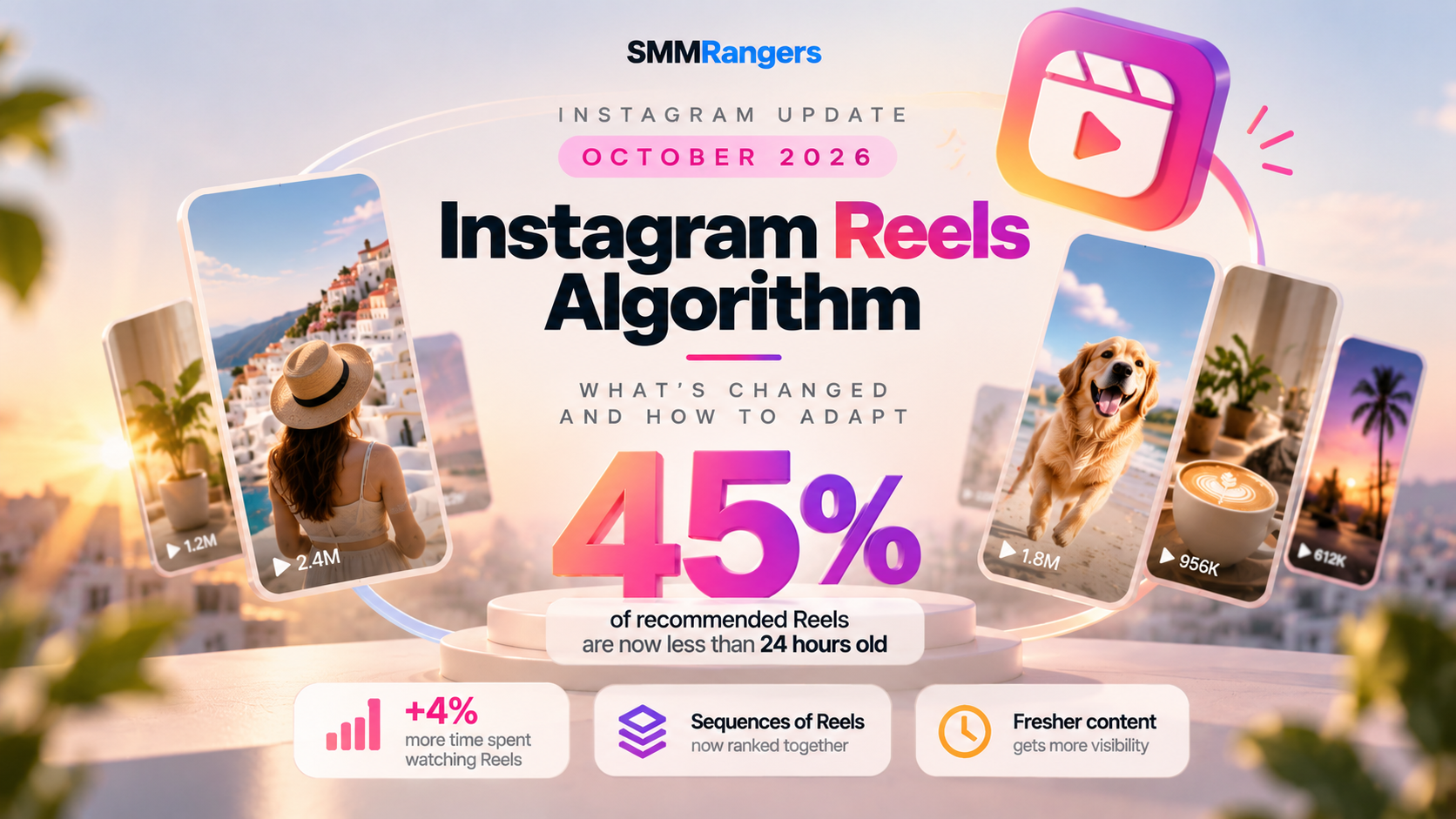
The company also reported that nearly 45% of recommended Instagram Reels are now less than 24 hours old.
So, what does this actually mean for creators, influencers, businesses, and anyone trying to grow on Instagram?
Let's break down the confirmed changes, explain what they don't mean, and explore practical ways to improve your Reels strategy.
What Changed in the Instagram Reels Algorithm in October 2026?
Meta disclosed several important developments during its third-quarter 2026 earnings call.
Three stand out.
1. Instagram now uses models that rank sequences of Reels
Previously, recommendation systems were often described as evaluating individual videos and predicting how likely someone was to interact with each one.
Meta says its upgraded architecture can now rank sequences of Reels together, rather than treating every video as an isolated recommendation.
Think of the difference this way.
Imagine someone watches a cooking tutorial, followed by a kitchen organization video and then a quick recipe.
Instead of considering only whether each individual Reel is relevant, a sequence-based model can evaluate how a series of recommendations works together.
That could help Instagram build a more personalized viewing experience.
However, Meta has not disclosed the exact technical rules governing these sequences.
What this means for creators: Consistently producing content for a recognizable audience is a reasonable strategy, but there is no confirmed rule that posting a particular sequence of videos will increase reach.
2. Instagram is using richer watch-time signals
Meta also described improvements that incorporate more detailed watch-time information into its recommendation models.
The company reported that its third-quarter Reels relevance improvements increased time spent watching Reels by more than 4%.
This is an important distinction:
The 4% figure measures the effect of Meta's recommendation improvements on Reels viewing time. It does not mean every creator received 4% more views.
It also does not mean likes, comments, shares, or saves have stopped mattering.
Rather, it shows that Meta continues to invest in understanding how people watch and respond to video content.
3. Nearly 45% of recommended Reels are less than one day old
Perhaps the most interesting figure concerns content freshness.
According to Meta, nearly 45% of recommended Instagram Reels were less than 24 hours old during the reporting period.
That share increased by more than 11 percentage points compared with the previous quarter.
This suggests that Instagram's recommendation system is surfacing a larger proportion of recently published videos.
But it does not establish that every new Reel receives an initial distribution boost, or that older Reels can no longer perform well.
It describes the composition of recommended content across the platform, not a guaranteed opportunity for an individual account.
Does Instagram Favor New Reels in 2026?
The latest figures suggest that newer content is becoming more prominent in recommendations.
That makes freshness worth considering in your content strategy.
However, there is a difference between a platform-wide trend and an individual ranking rule.
For example, suppose you publish a Reel at 9 AM.
You should not assume Instagram will automatically promote it for the next 24 hours.
Its performance may still depend on audience relevance, content quality, viewer behavior, and other factors that Meta has not fully disclosed.
A practical approach is to publish consistently enough to learn what works, without assuming that posting more frequently guarantees more views.
For creators covering news, trends, tutorials, or rapidly changing topics, publishing while the information is useful may be particularly sensible.
For evergreen content, relevance and long-term usefulness can remain valuable even after the first day.
Why Is Watch Time Important for Instagram Reels?
Watch time helps describe how much attention a video receives.
Consider two hypothetical Reels.
Reel A
10,000 views
8-second average watch time
30-second video length
Reel B
5,000 views
24-second average watch time
30-second video length
Reel A has more views.
Reel B has a higher average proportion of its duration watched.
Neither result alone proves which video Instagram will recommend more widely. The examples simply show why view counts and attention are different measurements.
Creators should examine available insights together rather than judging performance by one number.
Watch time vs. views
A view count reflects how often a video was viewed under Instagram's applicable measurement rules.
Watch time reflects viewing duration.
A video can accumulate many views without keeping people interested for very long.
Watch time vs. likes
A like is a visible interaction.
Watch time captures a different type of behavior.
Someone might watch a useful tutorial carefully without liking it.
Another person might like a funny video immediately and scroll away.
Both interactions provide information, but they are not interchangeable.
Watch time vs. engagement
Engagement can include likes, comments, shares, saves, and other interactions.
Watch time is better understood as an attention metric.
Meta's latest disclosure does not provide a universal formula for converting these signals into ranking outcomes.
How to Adapt Your Instagram Reels Strategy in 2026
You cannot directly control Instagram's recommendation models.
But you can improve the content experience and evaluate the results.
Here are seven practical approaches.
1. Make the first few seconds clear
People should quickly understand what your video offers.
Instead of opening a tutorial with a long introduction, show the problem or result first.
For example:
Weak opening: "Hey everyone, welcome back to my page."
Stronger opening: "Your Reels get views but no followers? Check these three things."
The second opening gives viewers an immediate reason to keep watching.
2. Match video length to the content
A 15-second demonstration may be enough to explain a simple tip.
A detailed tutorial may need a minute or longer.
Avoid making videos unnecessarily long just to accumulate more viewing time.
The goal is to deliver the promised value without losing the audience.
3. Create recognizable content themes
Because Meta has discussed sequence-based recommendations, it is worth thinking about how your videos fit into a coherent content strategy.
For example, a small business might publish a series about:
How a product is made
Common customer questions
Product care tips
Behind-the-scenes processes
Real customer experiences
These topics give interested viewers reasons to explore more content from the same account.
This is a content-planning recommendation, not a claim that Instagram guarantees extra reach to series.
4. Use on-screen text when it helps
Clear captions and visual explanations can make a Reel easier to understand.
This is especially useful for tutorials, demonstrations, and educational videos.
Keep text readable and avoid filling the screen with unnecessary information.
5. Review audience retention patterns
When relevant retention and watch-time insights are available for your account, look for patterns.
Do viewers leave during a long introduction?
Do they stay longer when you show the result first?
Does a particular video format consistently perform better?
Use these observations to guide future experiments.
6. Experiment with posting times
There is no universally perfect time to publish Instagram Reels.
Your audience's location, habits, and interests matter.
Try publishing similar content at different times and compare results over several weeks.
Avoid making decisions based on a single post.
7. Encourage meaningful interaction
A useful Reel can naturally lead to comments, saves, shares, and profile visits.
Ask relevant questions when discussion adds value.
For example, a creator sharing three editing techniques could ask viewers which technique they would use.
Avoid unrelated engagement bait that distracts from the actual content.
Why Are My Instagram Reels Getting Fewer Views?
A decline in views does not automatically mean Instagram has penalized your account.
Possible explanations include:
Audience mismatch: Your content may not align with the interests of the people seeing it.
Weak opening: Viewers may leave before understanding the video's value.
Content repetition: Repeating similar videos without new information may reduce audience interest.
Changing audience behavior: The types of content your followers prefer can change over time.
Competition: Many creators may be publishing similar material.
Account or recommendation eligibility issues: Some content may not qualify for recommendations under Instagram's rules.
Before assuming an algorithm penalty, check your available insights and Instagram Account Status.
Compare multiple posts, not just one disappointing result.
Also distinguish a temporary performance fluctuation from a persistent account-level problem.
Does Posting More Reels Increase Your Reach?
Not necessarily.
Meta's disclosure that a larger share of recommended Reels is fresh does not establish that posting more often automatically increases reach.
Publishing frequently can create more opportunities to test ideas.
But low-quality, repetitive, or rushed content may not serve your audience well.
A sustainable schedule is one you can maintain while consistently delivering useful material.
For some creators, that may mean several Reels per week.
For others, a different schedule may work better.
Let your audience data and production capacity guide the decision.
Instagram Reels Views, Likes, and Followers: What Should You Track?
Different metrics answer different questions.
| Metric | What it helps you understand |
|---|---|
| Views | How often your Reel was viewed under Instagram's measurement rules |
| Reach | How many unique accounts saw your content, where available |
| Watch time | How much viewing time your Reel accumulated |
| Average watch time | The average viewing duration reported in Insights |
| Likes | How many visible positive reactions it received |
| Comments | How much visible discussion it generated |
| Shares | How often people shared the Reel |
| Saves | How often people saved it for later |
| Follows | Whether viewers decided to follow your account |
If your goal is awareness, views and reach may be useful.
If your goal is community development, comments, shares, and relevant follows may be more informative.
If your goal is sales, website visits and conversions may matter more than any single engagement metric.
The right metric depends on what you're trying to achieve.
What Does the Reels Update Mean for SMM Panels?
SMM panels provide services organized around different social media metrics.
At SMMRangers, users can explore Instagram-related categories such as Reels Views, Likes, and Followers, depending on the services currently available.
But the latest Meta update makes one distinction especially important:
Purchased views are not the same thing as genuine viewer attention.
A service delivering a stated number of views should not be interpreted as a guarantee of higher average watch time, organic recommendations, or authentic audience growth.
Similarly, likes and followers represent different metrics and should not be treated as interchangeable.
Before evaluating any social media marketing service, review its description, limitations, and delivery conditions.
Also consider Instagram's policies regarding artificial engagement.
For creators and agencies, the strongest long-term strategy remains a combination of useful content, authentic audience relationships, and careful performance measurement.
Frequently Asked Questions
Did Instagram change its Reels algorithm in October 2026?
Meta disclosed new details on October 21 about recommendation improvements deployed during the third quarter of 2026. These include sequence-based Reels ranking and richer watch-time signals.
Is Instagram prioritizing Reels posted within the last 24 hours?
Meta reported that nearly 45% of recommended Instagram Reels were less than one day old. This indicates a greater share of fresh recommendations, but it does not prove that every new Reel receives preferential distribution.
Does watch time matter more than likes?
Meta emphasized improvements to watch-time modeling, but did not disclose a universal ranking formula proving that watch time always outweighs likes.
Will longer Reels perform better?
Not automatically. Video length should fit the topic and audience. Longer videos can provide more information, but they can also lose viewers if the content is unnecessarily stretched.
Why are my Instagram Reels stuck at low views?
Possible causes include audience mismatch, weak content openings, normal performance variation, competition, or recommendation eligibility issues. Review multiple posts and available account insights before drawing conclusions.
Can buying Instagram Reels views improve organic reach?
There is no reliable basis for promising that purchased views will improve organic recommendations. View counts and authentic viewing behavior are different, and artificial engagement can carry platform-policy risks.
Should I post Reels every day?
Daily posting is not a confirmed requirement for growth. Choose a sustainable schedule and use your performance data to decide whether more frequent publishing is worthwhile.
Final Thoughts: What Instagram's October 2026 Update Really Means
Meta's latest disclosures point to three important developments:
Instagram is improving how it evaluates sequences of Reels, using richer watch-time signals, and recommending a greater proportion of recently published videos.
For creators, this reinforces the value of content that captures attention and delivers something useful.
For businesses, it highlights the importance of evaluating video performance beyond raw view counts.
And for agencies and social media marketers, it provides a reason to revisit how Reels success is measured and reported.
The takeaway is not that there is a new algorithm trick to exploit.
It is that understanding audience attention, content relevance, and meaningful outcomes matters more than chasing a single metric.
Stay informed about Instagram updates, platform changes, and social media marketing trends with the SMMRangers blog.