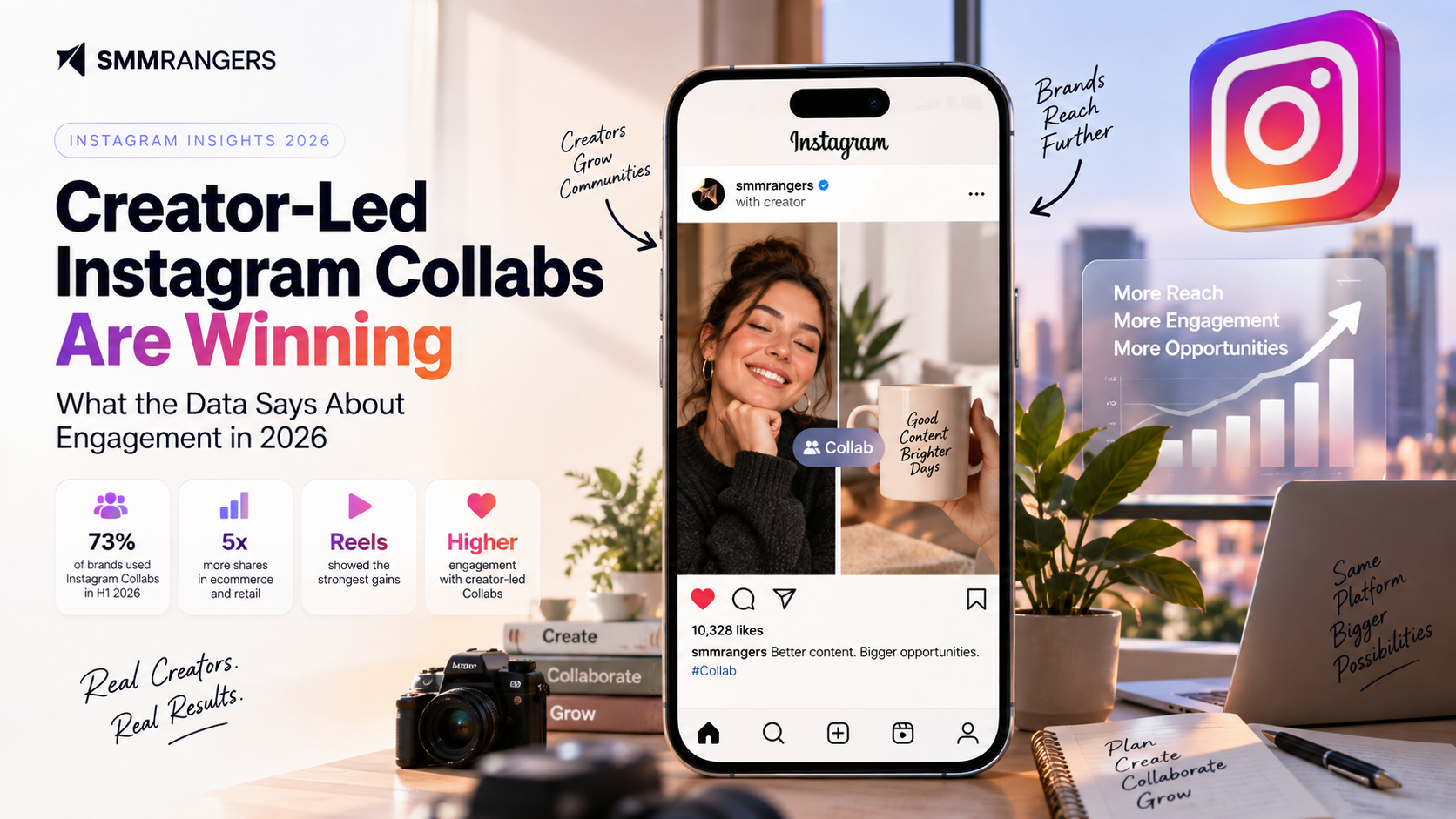
Creator-Led Instagram Collabs Are Winning: What the 2026 Data Shows
Short Answer: New H1 2026 data from Emplifi suggests that Instagram Collab posts outperform standard brand posts, with creator-published collaborations showing the strongest engagement and amplification gains. The findings do not prove that Collabs automatically receive an algorithmic boost. Instead, they highlight how creator trust, audience fit, distribution, content format, and shareability can work together to expand organic reach.
Key Takeaways
More than 73% of the brands analyzed by Emplifi used Instagram Collab posts in H1 2026.
Both brand-led and creator-led Collabs were associated with stronger performance than standard brand posts.
Creator-published, or “accepted,” collaborations produced the strongest engagement uplift across the dataset.
In ecommerce and retail, accepted Collabs generated more than 5x the shares and reposts of non-Collab posts.
Reels showed the strongest gains from collaboration, particularly when the creator published first.
The data does not prove that Instagram gives Collab posts a special algorithmic boost. Audience fit, creator credibility, content quality, format, and distribution remain critical.
Instagram Collabs Are Becoming More Than a Co-Posting Feature
Instagram Collabs have been available for years, but new performance data suggests marketers should think about them as more than a convenient way to put two names above the same post.
Instagram allows multiple accounts to co-author a feed post, carousel or Reel. Once a collaborator accepts an invitation, the content can appear on the participating accounts’ profiles and reach their respective audiences.
That distribution model creates an obvious advantage: instead of publishing content only through a brand’s existing audience, a collaboration can introduce the same piece of content to another established community.
But new data points to something more interesting.
Who publishes the collaboration may matter too.
Emplifi analyzed 520,198 Instagram posts and accepted collaborations across 3,791 brand profiles during the first half of 2026. The company divided collaborations into two broad categories:
Owned collaborations: The brand publishes the content and invites a creator or partner.
Accepted collaborations: A creator or partner publishes the content and invites the brand.
Both formats outperformed standard brand posts in Emplifi’s dataset.
But accepted — effectively creator-led — collaborations consistently produced the larger uplift.
That distinction matters because creator marketing is increasingly about more than gaining access to another account’s follower count.
It is about gaining access to another account’s relationship with its audience.
What the 2026 Instagram Collab Data Actually Shows
More than 73% of the brands included in Emplifi’s analysis published Instagram collaborative posts during H1 2026.
Collaboration was especially common among more established brands, which tended to have larger audiences, higher publishing activity and more mature creator programs.
That creates an important caveat.
Brands using Collabs may already have stronger social strategies, bigger budgets and better creator networks. Therefore, we should not conclude that using the Collab button alone causes better performance.
Emplifi explicitly acknowledges this limitation.
However, when the researchers compared different post types from the same brands, both owned and accepted collaborations tended to outperform their standard content.
And creator-led collaborations delivered the strongest uplift.
The effect extended beyond likes and comments.
Shares and Reposts Tell a More Interesting Story
In ecommerce and retail, accepted collaborations generated more than five times the amplification of non-Collab posts, measured through shares and reposts.
That metric deserves attention.
A like tells you someone reacted to content.
A share potentially introduces that content to another person.
Those are not equivalent outcomes.
Meta has previously explained that its recommendation systems use many predictions when deciding what content may be valuable to users, and sharing is one of the behaviors those systems can consider. No single signal determines distribution, but content that people actively pass along can have a different growth dynamic from content that simply accumulates passive interactions.
That is why marketers should stop evaluating creator campaigns purely through visible interaction counts.
The more useful question may be:
Did this collaboration make the content travel?
Why Creator-Led Collabs May Perform Better
There is no evidence that Instagram simply looks at a creator-published Collab and says, “boost this post.”
The explanation is likely more complicated — and more useful.
1. The Content Starts Inside an Existing Audience Relationship
Creators do not merely possess audiences.
Successful creators develop expectations with those audiences: a recognizable voice, recurring formats, familiar editing styles and a sense of what their followers will actually watch or share.
When branded content originates from that environment, it may feel closer to the creator’s normal content than an advertisement imported from a brand account.
2. Creators Understand Their Own Content Language
A brand may know its product better.
A creator often knows their audience better.
That distinction affects hooks, pacing, captions, visual language and even how prominently the brand should appear.
Giving creators meaningful creative control can therefore make the content better adapted to the audience consuming it.
3. Collabs Combine Distribution Networks
Instagram says accepted Collab posts can reach the audiences of participating collaborators.
That means the same asset is no longer confined to the brand’s existing follower graph.
For smaller brands in particular, that can be powerful.
Emplifi found that accepted Collabs from profiles with fewer than 10,000 followers generated roughly five times the interactions of those brands’ standard posts.
For a small account, collaboration can effectively provide access to a distribution network that would take much longer to build independently.
4. Shareable Content Compounds the Effect
If a creator introduces content to a relevant community and that community then shares it again, distribution can move beyond both the brand’s and creator’s immediate follower bases.
That creates a useful distinction:
Audience size determines potential exposure. Audience response determines whether content travels.
Reels Appear to Be the Strongest Collab Format
Format matters too.
Emplifi found that Reels produced the strongest collaboration gains, particularly for creator-led Collabs.
That aligns with the broader direction of Instagram.
Meta reported earlier in 2026 that 75% of Instagram recommendations in the United States were coming from original posts by Q4 2025, while the company continues investing heavily in recommendation systems and video discovery.
Reels are inherently suited to discovery beyond an existing follower base.
Combine that discovery architecture with a creator’s audience and a collaboration structure, and marketers gain several possible distribution layers:
creator audience → brand audience → Reels recommendations → shares/reposts → secondary audiences
That does not guarantee virality.
It does create more opportunities for good content to move.
Follower Count Is Becoming a Weaker Shortcut for Creator Selection
For years, influencer marketing was often simplified into a single question:
How many followers does this creator have?
That metric remains relevant, but it is increasingly inadequate on its own.
A creator with 500,000 followers and weak audience alignment may produce less meaningful impact than a creator with 50,000 highly relevant followers.
Brands should therefore evaluate creators using a broader set of signals:
audience relevance,
typical reach,
engagement quality,
shares and reposts,
content consistency,
audience geography,
format performance,
previous partnership results,
brand fit,
and conversion outcomes where measurable.
Meta itself is moving in this direction.
Its Creator Marketplace has increasingly incorporated tools designed to help businesses discover and evaluate creators, while Meta has also been consolidating creator discovery and Partnership Ads workflows into a broader Creator Marketing Hub.
The direction is clear: creator marketing is becoming more measurable and more performance-oriented.
What Should Marketers Do Now?
The Emplifi data should not be interpreted as “every brand should let every creator publish every campaign.”
Different objectives require different structures.
But it does provide several practical lessons.
1. Test Creator-Led and Brand-Led Collabs Separately
Compare standard brand posts, brand-published Collabs and creator-published Collabs separately.
You may discover that the publishing account itself materially changes performance.
2. Start With Reels When Discovery Is the Goal
If your objective is reach, discovery or community expansion, creator-led Reels deserve serious testing.
For campaigns requiring detailed product education or controlled messaging, carousels and brand-led formats may still make more sense.
3. Measure Amplification, Not Only Engagement
Likes and comments are useful, but also track:
shares,
reposts,
reach,
saves,
profile visits,
follower growth,
clicks,
conversions where available.
A post receiving fewer likes but substantially more shares may be more valuable for discovery.
4. Choose Creators for Audience Fit, Not Vanity Metrics
Large follower numbers can look impressive in a campaign spreadsheet.
They do not guarantee relevance.
A smaller creator whose community closely matches your target customer may provide stronger distribution quality.
5. Give Creators Enough Creative Freedom
Set clear brand boundaries and campaign objectives, then leave room for the creator to communicate naturally.
6. Connect Creator Strategy With UGC and Community Strategy
Emplifi also found that brands with stronger user-generated-content visibility tended to show stronger Collab performance.
Again, this is correlation rather than proof of causation.
But it reinforces an important principle: creator marketing works best when it connects to a broader community rather than operating as an isolated sponsored post.
What This Means for Social Media Growth
The biggest lesson from the 2026 Collab data extends beyond influencer marketing.
Raw numbers are not the same thing as growth.
A follower count describes audience size.
Views describe exposure.
Likes describe one type of interaction.
None of those metrics alone tells you whether people trust the account, share its content, return to it or take action.
Modern social growth is better understood as a system:
content quality × audience relevance × distribution × engagement quality × consistency
That has implications for creators, agencies, brands and the SMM industry.
Social media growth services may contribute to visibility, distribution or social proof depending on how they are used, but they cannot replace the underlying content and audience strategy.
This is an important distinction for platforms such as SMMRangers.
A useful social-growth toolkit should be evaluated not simply by the largest number available on a service page, but by factors such as service reliability, delivery characteristics, retention, audience relevance, support quality and how a service fits into the marketer’s broader objective.
A creator collaboration with genuinely shareable content plus a coherent distribution strategy is fundamentally different from chasing a number in isolation.
The Emplifi data helps illustrate why.
Creator Marketing Is Becoming Infrastructure
Meta is building more infrastructure around creator partnerships.
Instagram Creator Marketplace helps businesses discover creators and manage partnership opportunities. Partnership Ads allow advertisers to amplify creator content. Meta has also announced a Creator Marketing Hub designed to bring creator discovery and partnership-ad workflows closer together.
This suggests creator partnerships are moving from an experimental marketing tactic toward a more integrated part of the social advertising ecosystem.
Organic creator content can generate an initial performance signal.
Brands can identify what resonates.
High-performing creator assets can then move into paid amplification.
Performance data can inform the next partnership.
That creates a loop:
creator discovery → organic content → audience response → performance analysis → paid amplification → learning → better creator selection
The strongest brands will probably become better at managing that loop rather than simply signing more influencers.
What Happens Next?
Expect creator marketing to become more data-driven.
Brands will have better tools for identifying potential partners. Platforms will continue connecting organic creator performance with advertising systems. AI will make creator discovery and content analysis faster.
But better technology will not remove the central constraint:
people still decide what is worth watching and sharing.
That makes audience trust and content relevance more valuable, not less.
The strongest creator partnerships may therefore be those that produce content people would have wanted to consume even if there were no campaign behind it.
Collaboration expands distribution.
Good content gives that distribution somewhere to go.
Frequently Asked Questions
Do Instagram Collab posts get more engagement?
Emplifi's H1 2026 analysis found that both brand-led and creator-led Collab posts were associated with higher interactions than standard posts from the brands analyzed. Creator-led collaborations produced the strongest uplift. However, the research does not prove that the Collab feature itself causes higher engagement.
Are creator-led Instagram Collabs better than brand-led Collabs?
In Emplifi's dataset, creator-led or “accepted” collaborations consistently showed stronger engagement uplift. This is an observed performance pattern rather than a universal rule for every account or campaign.
Do Instagram Collabs receive an algorithm boost?
There is no reliable evidence showing that Instagram automatically gives Collab posts a special ranking boost. Collabs can reach participating accounts' audiences, which provides a distribution advantage without requiring a special algorithmic bonus.
Are Reels or Carousels Better for Instagram Collabs?
Reels generated the strongest collaboration uplift in Emplifi's H1 2026 analysis. Carousels can still be useful when campaigns require more explanation, product detail or controlled storytelling.
How Should Brands Measure Creator Collaborations?
Look beyond likes. Track shares, reposts, reach, saves, follower growth, clicks and business outcomes where possible. Compare creator-led Collabs against both brand-led collaborations and equivalent non-Collab content.
Does Follower Count Still Matter When Choosing Creators?
Yes, but it should not be used alone. Audience relevance, engagement quality, geography, content fit, historical performance and shareability provide important additional context.
Build Growth Around the Right Metrics
Social media growth works best when content, distribution, audience relevance and measurable engagement work together.
For marketers, agencies and resellers looking to support a broader social media strategy, SMMRangers provides access to social media growth services across multiple platforms.
The goal should not simply be choosing the biggest number available. Consider how each service fits into your wider content and growth strategy.