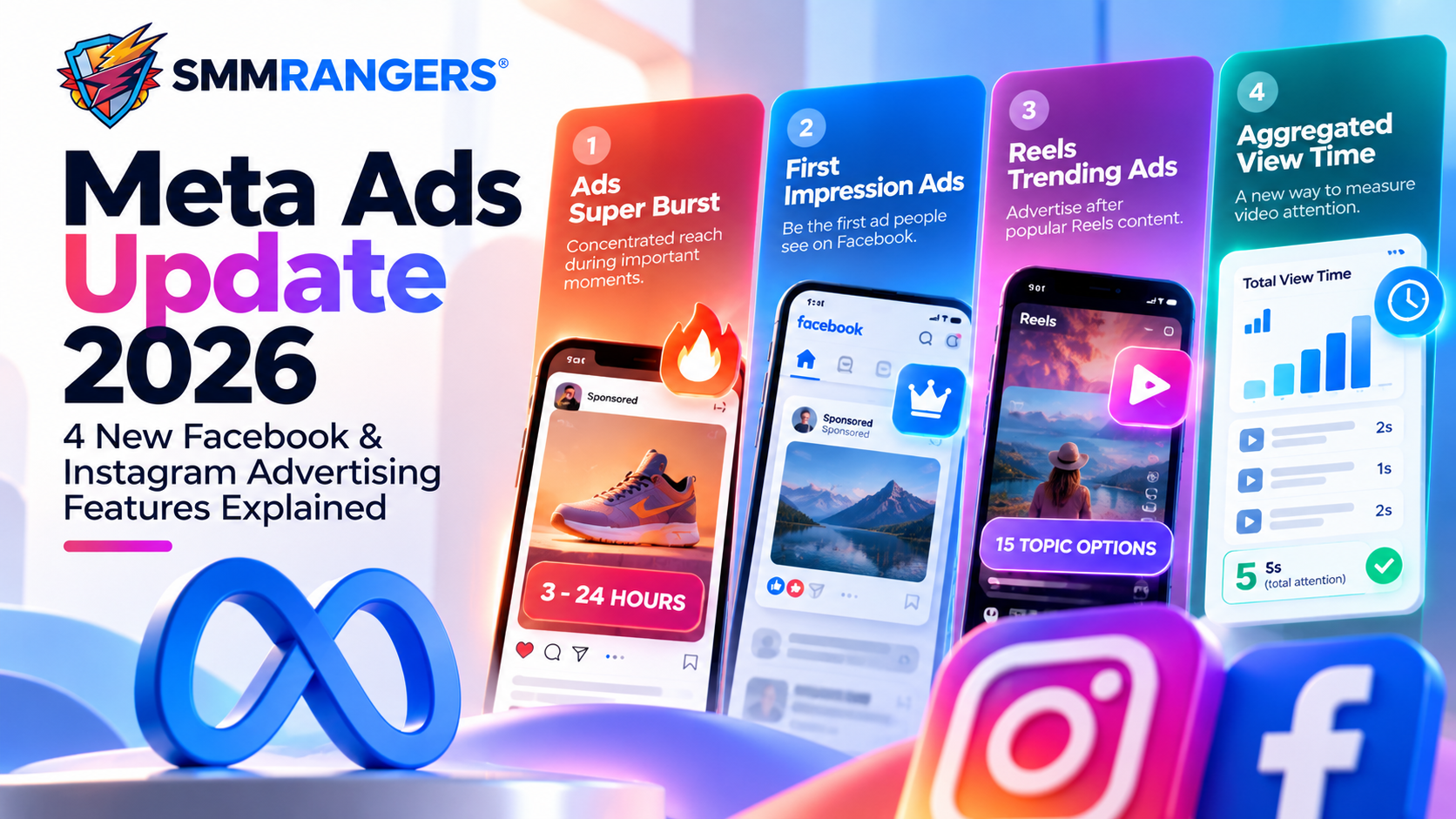
Meta Ads Update 2026: 4 New Facebook & Instagram Advertising Features Explained
October 18, 2026 | Social Media News & Digital Advertising
Meta is introducing new ways for brands to advertise across Facebook and Instagram, with a stronger focus on timing, premium placements, trending content, and audience attention.
At its Meta Brand Building Summit on October 15, 2026, the company announced four important advertising developments:
Ads Super Burst: Reserve concentrated advertising exposure during important moments.
First Impression Ads: Test premium placement as the first ad people see in Facebook Feed.
Reels Trending Ads: Reach audiences alongside popular Reels content with expanded topic options.
Aggregated View Time: Explore a new way to measure attention accumulated across multiple video exposures.
These updates reflect a broader shift in digital advertising.
Instead of focusing only on how many times an ad appears, Meta is developing tools to help advertisers consider when people see their messages, where those messages appear, and how attention accumulates over time.
But what do these features actually do, who can use them, and what do they mean for creators, agencies, and social media marketers?
Let's break them down.
What Is New in Meta Ads in October 2026?
Meta's latest announcements focus primarily on brand awareness and advertising visibility.
They are not simply new options for boosting a Facebook post or increasing Instagram engagement.
Instead, they include reserved advertising inventory, premium Feed positions, contextual Reels placements, and an experimental video measurement system.
Here's a quick comparison:
| Feature | Main Purpose | Availability |
|---|---|---|
| Ads Super Burst | Concentrated reach during important events | Phased rollout in October 2026 |
| First Impression Ads | First advertising position in Facebook Feed | Limited US test |
| Reels Trending Ads | Advertising after popular, culturally relevant Reels | Existing product with expanded options |
| Aggregated View Time | Measure cumulative attention to a brand | Early alpha testing |
Not every advertiser will see these features in their account immediately.
Availability can depend on the product, market, campaign eligibility, and rollout stage.
1. Ads Super Burst: Concentrated Advertising During Important Moments
Ads Super Burst is one of the biggest announcements from Meta's October 2026 event.
It allows eligible advertisers to reserve a concentrated advertising window lasting between 3 and 24 hours.
The idea is straightforward: Some marketing moments matter more than others.
For example, a brand may want particularly strong visibility during:
A product launch
A seasonal promotion
A major entertainment event
A sports season opening
A limited-time campaign
Rather than distributing advertising exposure evenly across several weeks, Ads Super Burst allows brands to concentrate their reach within a selected period.
How Does Ads Super Burst Work?
Advertisers can use Meta's Reach Planner to estimate campaign reach and pricing before reserving inventory.
The format also offers optional category exclusivity.
This means that another advertiser in the same category cannot reserve the same Super Burst window when that exclusivity applies.
Meta reports that early test campaigns reached a median of 34 million people per flight and generated a median 2.9-point lift in ad recall.
However, these are results reported by Meta from early campaigns. They are not guaranteed outcomes for future advertisers.
Is Ads Super Burst Available to Everyone?
Meta says the format is moving toward general availability through a phased rollout beginning in October 2026.
That does not mean every business account can book a campaign immediately.
For smaller businesses, ordinary Meta Ads campaigns may remain a more accessible starting point.
Why it matters: Ads Super Burst makes timing a more explicit part of premium brand advertising.
2. Facebook First Impression Ads: The First Ad People See
First Impression Ads is a new premium placement being tested in Facebook Feed.
The concept is simple but potentially valuable for advertisers.
When someone opens Facebook and begins browsing their Feed, a participating brand can occupy the first advertising position.
That placement offers a different kind of visibility from an ad appearing later in the browsing experience.
How Does First Impression Advertising Work?
According to Meta, the current test is limited to the United States.
The company is experimenting with a model that allows just one brand per day to occupy this premium advertising position.
The goal is to offer brands a prominent placement at the beginning of a user's Feed experience.
However, Meta has not announced broad availability or standard public pricing for the format.
Why Does First Ad Placement Matter?
Advertisers have long been interested in premium positions because the placement of a message can influence whether people notice it.
But placement alone does not guarantee engagement, conversions, or sales.
A successful campaign still depends on factors such as:
Creative quality
Audience relevance
Brand recognition
Campaign objectives
Landing page experience
Why it matters: First Impression Ads introduces a new way for brands to compete for prominent Facebook advertising inventory.
3. Reels Trending Ads: Advertising Alongside Popular Content
Short-form video remains a major focus for Meta.
Reels Trending Ads allows businesses to place advertisements immediately after popular and culturally relevant Reels on Facebook and Instagram.
This is different from simply publishing a Reel and hoping it becomes popular.
Reels Trending Ads is an official paid advertising product.
What's New in October 2026?
Meta has expanded the selection of topics available to advertisers.
The product now includes 15 standard, always-on topics, with newer options including Home & Garden and Spanish-language content.
There are also seasonal opportunities linked to major cultural moments.
Meta says it plans to introduce additional targeting controls, including custom audience exclusions, later in 2026.
Why Is This Important for Brands?
A brand may want its advertising to appear in a context that matches what its target audience is already interested in.
For example, a home décor business might benefit from advertising around relevant home and lifestyle content.
A sports-related brand might focus on seasonal sporting conversations.
The important distinction is that the advertiser is purchasing an official placement connected to trending content, not purchasing organic popularity.
Does Reels Trending Ads Guarantee More Engagement?
No.
The format is designed to provide advertising opportunities around popular content.
Actual performance depends on the campaign, audience, creative execution, and other factors.
Meta has reported encouraging results from campaigns using the format, but those findings should not be interpreted as universal guarantees.
Why it matters: Reels Trending Ads gives advertisers more control over the content context in which their messages appear.
4. Aggregated View Time: A New Way to Measure Video Attention
Aggregated View Time may be the most interesting announcement from a measurement perspective.
Traditionally, marketers have often evaluated video advertising through individual views, watch duration, and completion rates.
But short-form video consumption can be fragmented.
Someone might see a brand for two seconds on Monday, another second on Wednesday, and two more seconds on Friday.
Individually, those interactions appear brief.
Together, they represent five seconds of exposure to the same brand.
Meta's new Aggregated View Time concept aims to measure this cumulative attention.
How Does Aggregated View Time Work?
The proposed measurement system evaluates the total time someone spends viewing a brand's content across a week.
Rather than treating each exposure as a completely separate event, it considers how repeated moments of attention add up.
Meta says its research found that five seconds of attention accumulated across a week was associated with stronger offline sales outcomes than one continuous five-second exposure in the studied campaigns.
These are research findings reported by Meta, not a guarantee that repeated short views will outperform longer views for every business.
Is Aggregated View Time Available Now?
The product is in early alpha testing.
It is not yet a standard reporting metric available to every advertiser.
Why Could This Matter?
For agencies and advertisers, it introduces a potentially useful way to think about short-form video.
A single view count does not fully explain how much attention a brand receives over time.
However, marketers should still evaluate attention alongside meaningful business outcomes.
Why it matters: Meta is experimenting with measurement that reflects repeated exposure rather than relying only on individual video-view events.
What Do These Updates Mean for Instagram and Facebook Marketing?
Taken together, Meta's announcements highlight three important ideas.
Timing Is Becoming More Important
Ads Super Burst allows eligible brands to concentrate exposure during specific periods.
This may be useful when a campaign is connected to a launch, promotion, or cultural event.
Context Matters
Reels Trending Ads helps advertisers place messages near content that audiences are already watching.
This can make the surrounding content environment an important part of campaign planning.
Attention Is More Complex Than a View Count
Aggregated View Time recognizes that people may encounter a brand repeatedly through short interactions.
Marketers may eventually have more ways to assess those cumulative exposures.
These developments do not mean that follower counts, likes, or views are no longer relevant.
They mean that different metrics answer different questions.
Paid Advertising vs. Organic Reach vs. Social Media Engagement
One of the most common sources of confusion in social media marketing is treating all forms of visibility as interchangeable.
They are not.
| Metric or Activity | What It Represents |
|---|---|
| Paid advertising reach | People reached through a paid advertising campaign |
| Ad impressions | Times an advertisement is displayed |
| Organic reach | Distribution achieved without paid advertising placement |
| Reels views | Video views counted under the platform's applicable rules |
| Likes and reactions | Interactions recorded on content |
| Followers | Accounts following a profile |
| Website traffic | Visits to a website |
| Conversions | Actions such as purchases, sign-ups, or inquiries |
For example, 10,000 video views do not necessarily mean 10,000 unique people saw the content.
Similarly, an increase in followers does not automatically produce more website visits or sales.
And purchasing third-party engagement does not provide access to Meta's premium advertising placements.
Understanding these differences helps businesses set more realistic marketing objectives.
What Should Social Media Agencies and Resellers Do?
Meta's new features are particularly relevant for agencies managing advertising campaigns and social media accounts.
However, not every feature is appropriate or available for every client.
Here are four practical considerations.
1. Match the Campaign Objective to the Tool
A product launch focused on broad awareness may require a different advertising approach from a campaign designed to generate immediate purchases.
Choose metrics and tools based on the business objective.
2. Understand Which Features Are Available
Do not promise clients access to a product that is still being tested or gradually released.
First Impression Ads and Aggregated View Time, for example, have limited availability.
3. Keep Paid and Organic Performance Separate
Report paid advertising results separately from organic content performance and third-party engagement metrics.
Combining them without explanation can produce misleading conclusions.
4. Evaluate More Than Visibility
Reach and views can help describe exposure, but businesses should also examine relevant outcomes such as qualified traffic, inquiries, and conversions.
For reseller businesses, clear service descriptions and transparent customer communication remain important.
Where Does SMMRangers Fit Into This Changing Landscape?
At SMMRangers, customers can explore social media services across platforms including Instagram, Facebook, YouTube, TikTok, and X.
These services should be understood separately from Meta's official advertising products.
For example, an Instagram Reels views service is not the same as a Reels Trending Ads campaign purchased through Meta.
Likewise, Facebook reactions or followers are not equivalent to paid advertising reach or conversion performance.
Different services have different stated features, limitations, and potential risks. Artificial engagement may violate platform rules, and it does not guarantee organic distribution or business growth.
For customers and resellers, understanding those differences is essential before making marketing decisions.
If you're new to the ordering process, read our SMM Panel Beginner's Guide.
For operational questions, our SMM Panel Order Status Guide explains common statuses such as Pending, Processing, Completed, and Partial.
SMMRangers also publishes updates about social media platforms and digital marketing trends to help readers make more informed decisions.
Frequently Asked Questions
What is the latest Meta Ads update in October 2026?
Meta announced Ads Super Burst, First Impression Ads, expanded Reels Trending Ads options, and an experimental measurement product called Aggregated View Time on October 15, 2026.
What is Ads Super Burst?
It is an advertising product that allows eligible brands to reserve concentrated reach during a 3–24-hour period, with optional category exclusivity.
Are Facebook First Impression Ads available to everyone?
No. The format is currently being tested in the United States with limited participation.
What are Reels Trending Ads?
They are official Meta advertising placements that allow businesses to show ads immediately after selected trending Reels content on Facebook and Instagram.
How many topics are available for Reels Trending Ads?
Meta says the product now offers 15 standard, always-on topic options, alongside seasonal opportunities.
What is Aggregated View Time?
It is an experimental measurement product designed to evaluate how much time a person spends viewing a brand across multiple exposures during a week.
Can small businesses use these new Meta advertising features?
Availability varies. Some features are rolling out gradually, while others remain in limited testing. Small businesses should check which options are available to their advertising accounts.
Do these updates change Instagram's organic algorithm?
Meta has not presented these advertising announcements as a new organic Instagram ranking algorithm.
Are SMM panel services the same as Meta Ads?
No. Meta Ads are official paid advertising products. Third-party SMM panel services are separate offerings and should not be represented as equivalent to official advertising placements.
Final Thoughts
Meta's October 2026 advertising updates show how the company is expanding its approach to brand visibility.
Ads Super Burst focuses on important moments.
First Impression Ads explores premium placement.
Reels Trending Ads connects advertising with popular content.
Aggregated View Time introduces a different way to think about repeated audience attention.
Together, they reflect an advertising environment where timing, context, and meaningful attention matter alongside reach and impressions.
For creators, agencies, and businesses, the lesson is not to abandon familiar social media metrics.
It is to understand what each metric actually measures and choose marketing tools that match real business goals.
For more social media news, marketing guides, and SMM panel education, explore SMMRangers.
Sources and Further Reading
Search Engine Land — Meta Introduces New Brand Advertising Formats Across Facebook and Instagram
Social Media Today — Meta Offers Enhanced Ad Campaign Exposure
Editorial note: Feature availability, eligibility, and performance may change. Results reported by Meta are not guaranteed outcomes for individual advertisers.