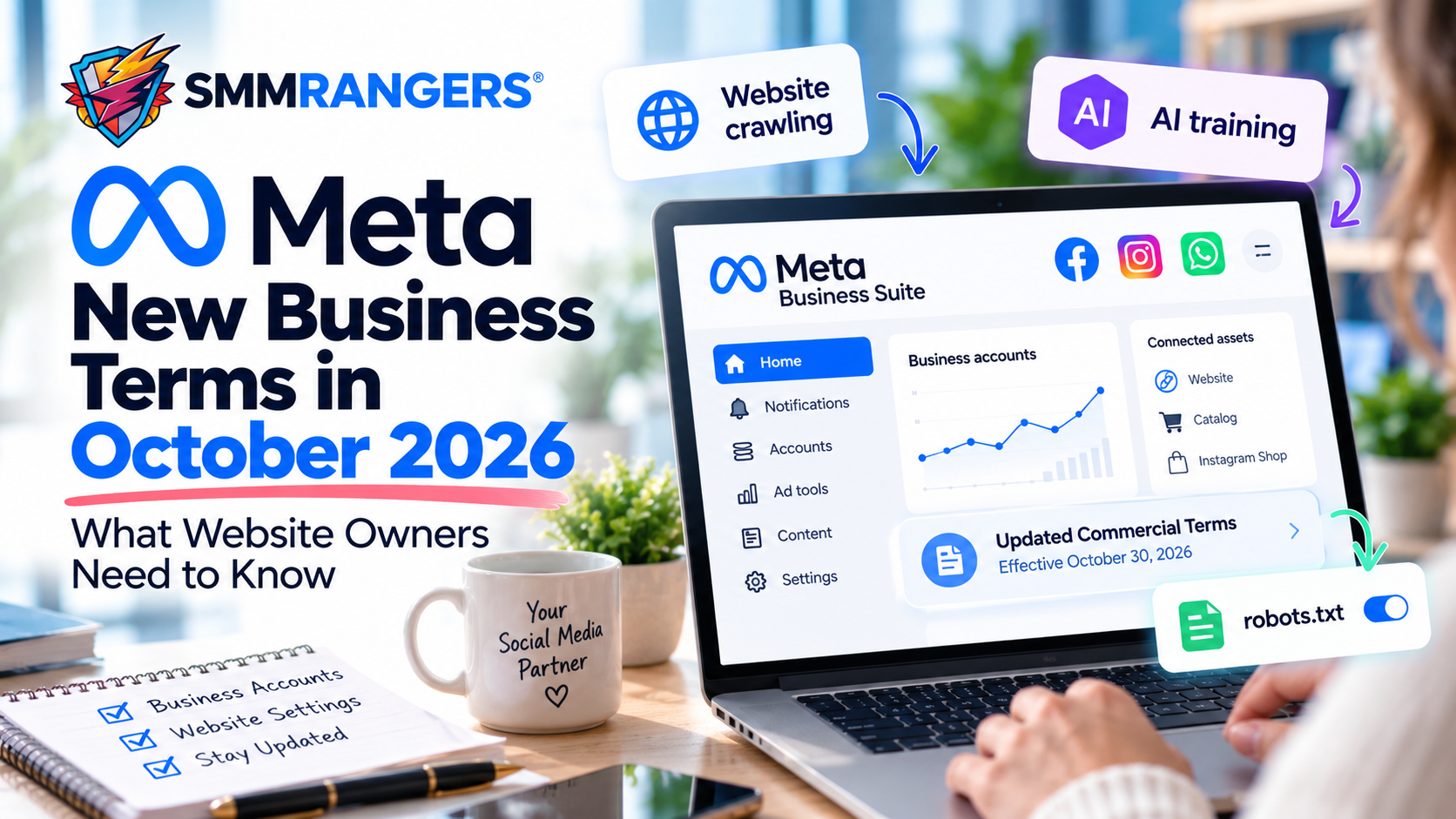
Meta's New Business Terms in October 2026: What Website Owners Need to Know
Social Media & AI News | October 17, 2026
If you use Facebook, Instagram, or WhatsApp for business, an important update to Meta's commercial terms is approaching.
Starting October 30, 2026, Meta's updated Commercial Terms will include broad language authorizing automated access to websites associated with businesses using its products.
The updated terms also describe how content collected from those websites may be used to develop, improve, research, and train Meta products.
The announcement has raised questions among website owners, publishers, digital marketing agencies, and businesses that rely on Meta's platforms.
Does this mean Meta can crawl your website? Will your content be used for AI training? Can you control which crawlers access your pages?
Here's what has been confirmed, what remains uncertain, and what businesses should check before the new terms take effect.
What Is Changing in Meta's Business Terms?
Meta is updating its Commercial Terms, which govern various business and commercial uses of its platforms.
The updated language authorizes Meta and entities acting on its behalf to use automated tools to access, index, analyze, collect, and retrieve content from websites associated with a business's products or services.
These tools can include web crawlers, bots, and other automated systems.
The terms also describe potential uses of collected content, including product development, research, improvement, and training.
This language has attracted particular attention because Meta operates AI-powered products and services.
However, the existence of a broad contractual permission does not prove that Meta is immediately changing how it crawls every business website.
Meta has stated that the update consolidates existing terms and does not change its current web-crawling practices.
When Do Meta's New Commercial Terms Take Effect?
The updated Commercial Terms are scheduled to take effect on October 30, 2026.
Businesses using Meta products for commercial purposes should review the terms before that date.
The relevant activities may include:
Managing business pages or professional accounts
Running Facebook or Instagram advertising campaigns
Using Meta Business Suite
Selling or promoting products through Meta services
Using certain business messaging or commerce tools
The exact applicability depends on the services being used and the relevant contractual terms.
According to reporting by Nieman Journalism Lab, the updated terms do not provide a separate option to reject the new commercial agreement while continuing the covered business use.
Businesses that do not agree are directed to stop using the relevant products for commercial purposes.
Can Meta Crawl Websites Connected to Facebook and Instagram Business Accounts?
The updated terms contain language permitting Meta to access websites and URLs associated with products or services connected to its commercial tools.
This is broader than simply reading the content a business posts directly on Facebook or Instagram.
For example, a business might have an Instagram professional account that links to its online store.
Its website may contain product descriptions, articles, pricing information, and other publicly accessible material.
The new terms raise questions about how Meta may access and use such information.
However, the precise boundaries of the language remain disputed.
It is not established that every website linked from a business profile will be fully collected or used for AI training.
The distinction between what a contract permits and what a company actually does is important.
Is Meta Using Business Websites to Train AI?
The updated commercial language includes permission to use website content to train Meta products.
That has raised concerns about whether content from business websites could contribute to AI development.
Legal experts interviewed by Nieman Journalism Lab have argued that the wording could give Meta broad permissions, particularly concerning publishers and other organizations producing original content.
Meta has offered a narrower explanation.
The company says the changes consolidate existing contractual provisions and are not intended to introduce new crawling practices.
Meta representatives have also explained that the relevant systems help the company obtain accurate information about products and services for advertising and content recommendations.
What is confirmed: The updated terms include language covering automated website access and training.
What is not confirmed: That Meta will begin collecting every connected business website in full on October 30.
Businesses should avoid assuming either that nothing matters or that every possible use described by the terms is already happening.
What Is robots.txt, and Can It Control Meta Crawlers?
A robots.txt file is a set of instructions that website owners can publish to communicate crawling preferences to automated systems.
It can indicate which parts of a website particular crawlers should or should not access.
Meta has stated that website owners can continue using robots.txt to manage crawler access.
Its developer documentation describes different crawlers and their purposes.
However, robots.txt is not a security barrier. Its effectiveness depends on crawlers respecting the published instructions.
Legal experts have also raised questions about how the new contractual language interacts with website-level crawling preferences.
For that reason, businesses should not treat a robots.txt rule as a guaranteed legal or technical solution to every concern about data use.
If you manage a website, review Meta's current crawler documentation before making changes.
Blocking the wrong crawler could also affect useful functions such as link previews.
Why Does This Matter for Digital Marketing Agencies?
Agencies often manage several connected digital assets for clients.
These may include:
Facebook Pages
Instagram professional accounts
Meta advertising accounts
Business websites
Online stores
Product catalogs
When platform terms change, agencies need to understand which business activities and connected websites may fall within their scope.
This does not mean agencies must immediately disconnect client accounts.
It means they should review the relevant terms, identify affected services, and discuss material concerns with website owners.
Agencies managing proprietary research, subscriber-only content, or sensitive business information may have additional reasons to examine their website access controls.
What Does This Mean for SMM Panel Owners and Resellers?
SMM panel operators and resellers frequently use social media business accounts to communicate with customers, publish announcements, and promote services.
Many also maintain websites containing service catalogs, educational articles, and customer-support information.
Meta's updated terms therefore raise a relevant website-management question for these businesses.
But there is an important limitation.
No verified evidence currently shows that this commercial terms update directly changes SMM panel API connections, follower delivery, refill eligibility, or order processing.
Those operational topics should not be confused with website crawling permissions.
For resellers, the practical lesson is to stay informed about platform agreements and understand how their websites interact with external services.
At SMMRangers, we publish educational resources to help users understand social media services and common order-management questions.
If you're new to panel operations, our step-by-step SMM panel ordering guide explains the basic customer journey.
For delivery-related questions, our SMM Panel Order Status Guide explains common order statuses.
These topics are separate from Meta's new commercial terms, but they are part of understanding the wider environment in which digital service businesses operate.
5 Things Website Owners Should Check Before October 30
1. Review the Updated Commercial Terms
Read the current agreement that applies to your business's use of Meta products.
Pay attention to provisions covering connected websites, automated access, content use, and product development.
2. Identify Your Connected Business Assets
Review the websites, online stores, product catalogs, and other digital properties associated with your business accounts.
Understanding these connections can help you determine which assets may be relevant.
3. Check Your Website's Crawling Preferences
Ask your website administrator or developer to review your existing robots.txt configuration.
Consult Meta's current developer documentation before blocking specific crawlers.
4. Review Sensitive or Restricted Content
Check whether information intended to remain private is properly protected through authentication and access controls.
Do not rely on robots.txt alone to protect confidential information.
5. Monitor Official Clarifications
The scope of the updated terms and their interaction with website controls remain subjects of discussion.
Follow Meta's official documentation for further clarification.
If your organization publishes licensed, proprietary, or subscriber-only material, consider obtaining professional advice about the implications of the agreement.
Does This Update Affect Instagram Followers, Likes, or Views?
There is currently no confirmed direct connection between Meta's updated Commercial Terms and the delivery of Instagram or Facebook engagement services.
The reported change concerns contractual permissions relating to commercial products and connected websites.
It should not be presented as evidence of a new Instagram algorithm, a follower-removal campaign, or an SMM provider disruption.
Those would require separate evidence.
Businesses should continue evaluating social media performance using relevant platform analytics and verified service information.
Frequently Asked Questions
When do Meta's new business terms start?
The updated Commercial Terms are scheduled to take effect on October 30, 2026.
Do the terms apply only to Facebook advertisers?
No. The scope of Meta's commercial terms extends beyond advertising and can include other business uses of its products.
Can Meta crawl a website linked to a business account?
The updated language grants broad permissions for automated access to associated websites. The precise scope and practical application remain subjects of discussion.
Will Meta use every business website to train AI?
That has not been established. The terms include training-related language, but they do not prove that every connected website will be collected and used for AI training.
Can I block Meta crawlers?
Meta says website owners can continue managing crawler access through robots.txt. However, the effectiveness and contractual implications of those instructions should not be treated as settled in every situation.
Does this change Instagram's algorithm?
No Instagram ranking algorithm change has been established by this commercial terms announcement.
Will the update affect SMM panel orders?
There is no verified direct impact on SMM panel order delivery, API connections, or refill processing.
Should businesses stop using Meta products?
That is a decision each organization must make based on the applicable terms and its own circumstances. Businesses should review the agreement and seek professional advice when necessary.
Final Thoughts
Meta's October 2026 Commercial Terms update raises important questions about how business websites interact with large social media platforms and AI-powered products.
The contractual language is broad, but its practical implications should not be overstated.
Meta says its current crawling practices are not changing, while legal experts have questioned how the updated permissions could be interpreted.
For website owners, agencies, and SMM panel resellers, the most useful response is to review the terms, understand connected assets, and monitor official clarification.
Staying informed about platform changes is an essential part of managing a digital business.
For more social media marketing updates and practical SMM panel guides, visit SMMRangers.
Continue Learning
How to Place Your First SMM Panel Order: A Step-by-Step Beginner's Guide
SMM Panel Order Status Explained: Pending, Processing, Completed & Partial
Sources and Further Reading
Ars Technica — Meta May Use Sweeping New Commercial Terms to Avoid AI Licensing Fees
The Verge — Meta's New Terms May Allow It to Train AI on News Sites
Disclaimer: This article provides general information about a developing platform-policy issue and is not legal advice. Businesses should review the applicable terms and official documentation before making decisions.