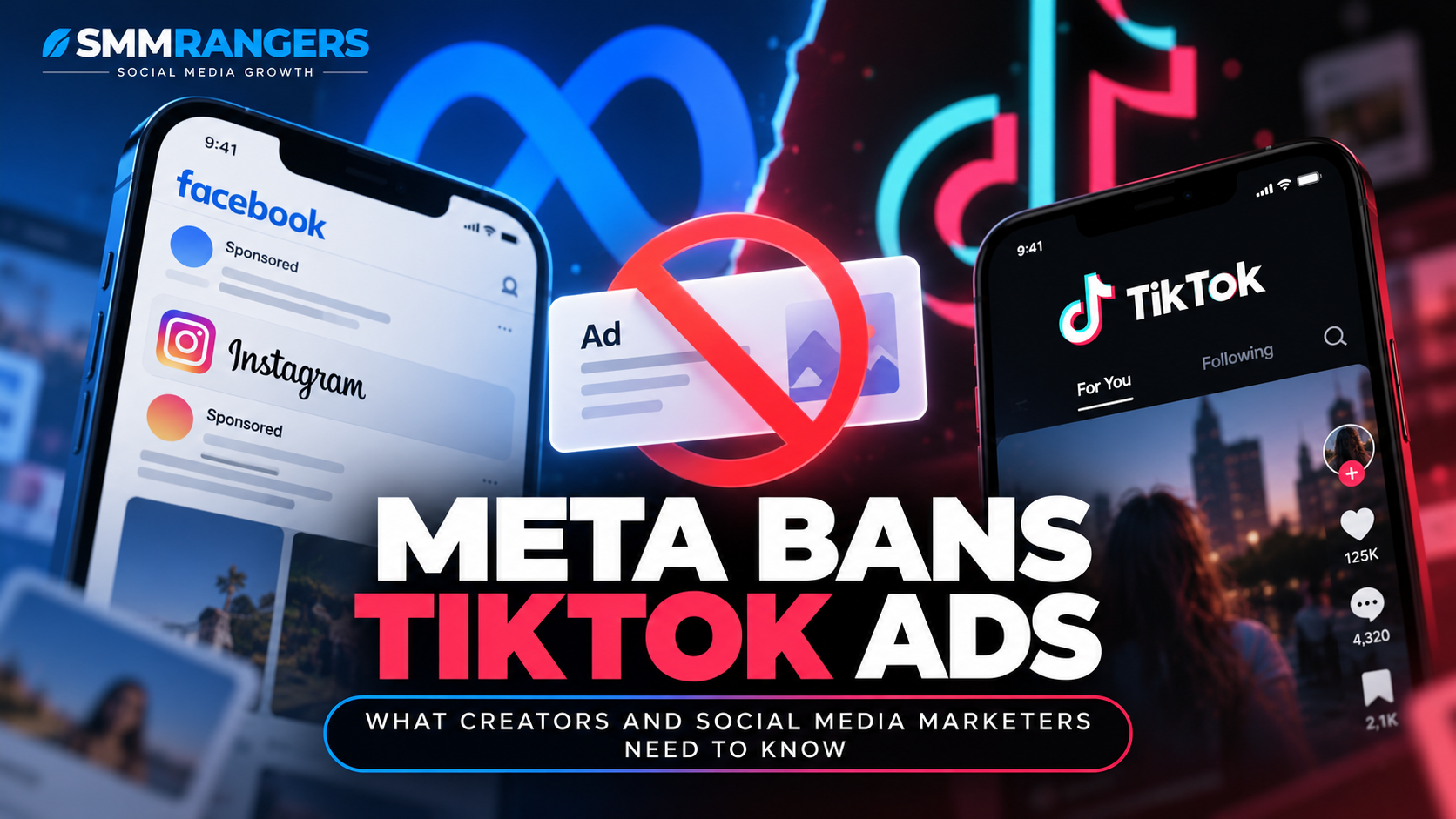
Meta Bans TikTok Ads in 2026: What Creators and Social Media Marketers Need to Know
Updated: October 9, 2026
Meta has introduced a new advertising restriction affecting TikTok and its parent company, ByteDance.
The decision immediately raises questions for creators, brands and social media agencies that use Instagram and Facebook to promote content across multiple platforms.
Can you still promote a TikTok account on Instagram? Are all TikTok links banned? Does this change how creators should grow their audiences?
The answers depend on an important distinction: paid advertising is not the same as organic social media activity.
Here's what changed, which countries are affected and what marketers should consider next.
What Happened? Meta Blocks TikTok-Related Advertising
On October 8, 2026, Meta confirmed that it had restricted advertisements from ByteDance, the company behind TikTok, across its advertising platforms in several countries.
According to Reuters' October 8 report, the restriction also extends to third-party advertisers running campaigns that direct users to TikTok and other ByteDance properties in the affected markets.
Meta described the decision as a commercial choice related to competition between platforms.
The restriction took effect immediately.
This is significant because Instagram and Facebook are commonly used to reach audiences who may also be active on TikTok.
However, the announcement should not be interpreted as a universal ban on mentioning TikTok or sharing TikTok content.
Which Countries Are Affected by Meta's TikTok Advertising Ban?
The restriction currently covers seven countries:
| Country | Reported restriction |
|---|---|
| United States | TikTok/ByteDance-related advertising restricted |
| Canada | TikTok/ByteDance-related advertising restricted |
| Egypt | TikTok/ByteDance-related advertising restricted |
| Indonesia | TikTok/ByteDance-related advertising restricted |
| Japan | TikTok/ByteDance-related advertising restricted |
| Thailand | TikTok/ByteDance-related advertising restricted |
| Vietnam | TikTok/ByteDance-related advertising restricted |
The announcement does not establish that the same restriction applies worldwide.
For example, Turkey was not among the seven countries identified in the initial report.
That does not guarantee that policies will remain unchanged or that every TikTok-related campaign outside those countries will be approved.
Advertisers should always check the current rules and campaign review results in Meta Ads Manager.
Can You Still Promote TikTok on Instagram?
This is likely to be one of the most important questions for creators.
The answer depends on how the promotion is being conducted.
Paid Instagram and Facebook Ads
If an advertiser runs a paid campaign in an affected market and directs users to TikTok or another ByteDance property, the campaign may fall under the new restriction.
This can affect brands, agencies and independent creators using Meta advertising to send traffic to TikTok.
Organic Instagram Posts
Organic Instagram posts are different from paid advertising.
The reported decision concerns advertising restrictions. It does not establish a blanket prohibition on every organic post that mentions TikTok.
Creators should not assume that all cross-platform promotion has been banned.
Instagram Stories and Profile Links
The announcement does not, by itself, establish that ordinary profile links or organic Story links to TikTok have been universally prohibited.
However, the rules governing paid promotion, branded content and individual platform features may differ.
The safest approach is to check the specific placement and promotion method rather than treating all Instagram activity as one category.
Why Did Meta Ban TikTok Ads?
Meta and TikTok compete for users, creators, attention and advertising revenue.
Both platforms want people to spend time discovering content within their own ecosystems.
Allowing a competitor to purchase advertisements that encourage users to leave the platform creates an obvious commercial tension.
Meta's reported position is that it is not obligated to provide advertising services to a direct competitor seeking to redirect users elsewhere.
For marketers, the important lesson is not simply that two technology companies are competing.
It is that access to an advertising channel can change even when a marketing strategy has worked in the past.
A creator who depends heavily on Instagram advertisements to attract TikTok followers may need to reconsider that approach in affected markets.
What Does This Mean for TikTok Creators?
The restriction does not mean TikTok itself has stopped growing or that creators can no longer promote their content.
It means one particular cross-platform paid advertising route has become more restricted in certain markets.
Creators should consider several questions.
Are You Depending on One Source of Traffic?
If most new viewers come from a single advertising channel, changes to that channel can create problems.
A more resilient strategy may include organic content, search discovery, community participation, creator collaborations and advertising channels that remain available.
Is Your TikTok Content Discoverable?
TikTok is increasingly used for discovering products, tutorials, entertainment and recommendations.
Creators should pay attention to relevant topics, clear descriptions, searchable language and content that answers real audience questions.
Are You Measuring the Right Outcomes?
A campaign that brings profile visits may not necessarily produce engaged followers.
Likewise, a video with many views does not automatically generate website traffic, customers or sales.
Creators should evaluate meaningful outcomes rather than relying on a single metric.
What Does the Ban Mean for Social Media Agencies?
For agencies managing campaigns across multiple platforms, the update is