YouTube Live Is Becoming a Growth Engine: What Creators and Marketers Should Know in 2026
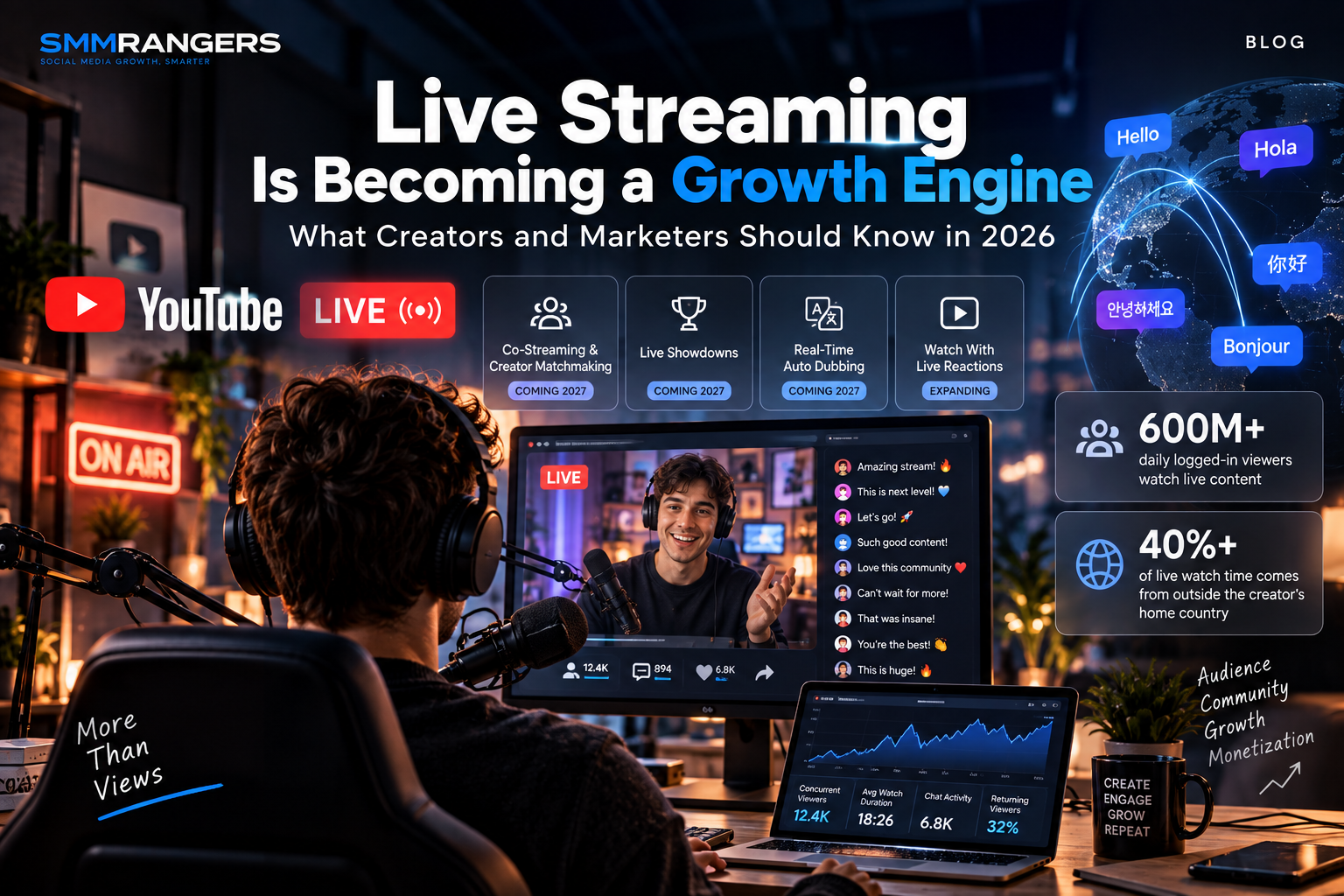
YouTube just gave creators a strong reason to take live streaming more seriously. At Made on YouTube on September 23, the platform announced new Live features including creator matchmaking, interactive Live showdowns, expanded Watch With reactions and real-time auto dubbing. The bigger signal, however, may be the audience: YouTube says more than 600 million logged-in viewers watched live content, including archived streams, each day on average in August 2026.
Short Answer
YouTube is turning live streaming into a broader growth, community and monetization channel. New tools for co-streaming, fan participation, reactions and real-time translation could help creators reach new audiences and deepen engagement. But successful Live growth cannot be measured by viewer count alone: watch time, retention, participation and returning viewers matter too.
Key Takeaways
YouTube says more than 600 million logged-in viewers watched live content, including archived streams, each day on average in August 2026.
Live showdowns will turn chats, gifts and Super Chats into interactive competitions between creator communities.
Go Live Together will gain creator discovery and matchmaking capabilities in early 2027.
YouTube plans to pilot real-time Live auto dubbing in early 2027.
More than 40% of YouTube Live watch time currently comes from viewers outside a creator's home country.
For creators and marketers, raw viewer counts should be interpreted alongside watch time, retention, engagement and business outcomes.
YouTube Is Making a Bigger Bet on Live
Live streaming has been part of YouTube for years.
What is changing is the role YouTube appears to want Live to play.
At Made on YouTube 2026, the platform announced several features designed not simply to make broadcasting easier, but to connect creators with new audiences, make communities more interactive and create additional monetization opportunities.
The scale helps explain why.
According to YouTube, in August 2026 more than 600 million logged-in viewers watched live content—including archived live streams—each day on average.
That figure should be interpreted carefully: it includes archived live content rather than only people watching broadcasts in real time.
Even with that qualification, it demonstrates the scale of the Live ecosystem.
A year earlier, YouTube reported that more than 30% of its daily logged-in viewers watched live content during Q2 2025. Since then, the company has continued investing in Live discovery, production, interaction and monetization.
The latest announcements push that strategy further.
Live is increasingly becoming a system built around:
discovery → participation → community → retention → monetization
That is much more interesting than simply counting how many people entered a stream.
Four YouTube Live Changes Marketers Should Understand
1. Go Live Together Is Becoming a Creator Discovery Tool
Co-streaming is not new to YouTube, but the next version changes how creators can find each other.
Previously, creators could invite an offline guest through a link.
Beginning in early 2027, YouTube says creators will be able to browse other creators who are already live and invite them to stream together. A quick-match system will also be able to pair creators with similar streamers they may not already know.
That introduces a discovery mechanism inside live broadcasting itself.
For creators, the opportunity is obvious: two communities can meet in real time.
For marketers, it creates another form of collaborative distribution.
Instead of creator partnerships being limited to edited videos or sponsored posts, live collaborations can potentially introduce audiences to each other while the content is happening.
It follows a broader social media pattern.
Collaboration is increasingly becoming a distribution strategy.
Instagram Collab posts combine audiences around the same piece of content. Creator partnerships introduce brands to established communities. YouTube is now building more of that network effect directly into Live.
The interesting metric will not simply be how many viewers a collaboration attracts.
It will be how many stay, participate and return afterward.
2. Live Showdowns Turn Engagement Into Part of the Content
YouTube is also introducing Live showdowns in 2027.
Two co-hosting creators will be able to start a friendly head-to-head competition. Viewer activity—including chats, gifts and Super Chats—will move an on-screen score in real time.
That may sound like a simple gamification feature.
Strategically, it represents something bigger.
Normally, engagement happens around content.
With formats like Live showdowns, engagement becomes part of the content itself.
The audience is no longer only watching the event. Its behavior changes what happens on screen.
That creates a feedback loop:
content → participation → visible result → more participation
For creator businesses, that can deepen community involvement while creating additional fan-funding opportunities.
For marketers, it is another reminder that live audiences behave differently from passive reach.
A viewer who stays for 20 minutes, joins the chat and participates in a community event represents a different type of attention from someone who briefly encounters a video in a feed.
Both can be valuable.
They simply should not be measured as if they are the same thing.
3. Watch With Expands Live Reactions
YouTube is also expanding Watch With.
The feature began around major live broadcasts and later expanded into testing live reactions between creator streams.
Now YouTube plans to allow creators to react live to eligible long-form videos across the platform, with rollout beginning later in 2026.
The economics are noteworthy.
According to YouTube, the reacting creator keeps the live advertising revenue and fan funding generated by their stream. The creator of the original video receives attribution and additional view credit in YouTube Studio, while retaining control over whether their videos can be used.
That effectively turns existing video content into material around which new live communities can form.
It also demonstrates how blurred the line between content creation and content distribution is becoming.
One video can potentially generate:
an original upload,
a recommendation,
a reaction,
a live discussion,
community interaction,
and additional discovery.
The value of content increasingly extends beyond the initial upload.
4. Live Auto Dubbing Could Make Live Audiences Global
Perhaps the most strategically interesting announcement is Live auto dubbing.
YouTube says more than 40% of live watch time comes from viewers outside a creator's home country.
Language remains an obvious barrier.
Starting in early 2027, YouTube plans to pilot technology that automatically translates a creator's speech in real time so viewers can listen in their preferred language.
If it works reliably at scale, this could fundamentally change the addressable audience for some live creators.
Until now, AI dubbing has been particularly useful for recorded video because translation can happen after content is produced.
Live translation presents a harder challenge: speech must be understood, translated and delivered quickly enough for a real-time conversation to remain useful.
It also creates additional risks.
Translation quality, humor, cultural context, names and technical language can all be difficult for automated systems.
Creators therefore should not assume that automatic translation equals perfect localization.
But the direction is clear.
Live streaming is becoming less geographically constrained.
And that makes audience geography, language and relevance more important—not less.
A Large Live Viewer Number Is Not Automatically a Valuable Live Audience
This is where live-streaming growth can easily be misunderstood.
A stream showing 10,000 viewers looks more successful than one showing 1,000.
Sometimes it is.
Sometimes the second stream has the more valuable audience.
Viewer count answers only one question:
How many people were present?
It does not answer:
How long did they stay?
Did they participate?
Did they return?
Did they subscribe?
Did they visit another piece of content?
Did they become customers?
Did they support the creator?
Understanding live performance therefore requires several layers of measurement.
Concurrent Viewers
Concurrent viewers measure how many people are watching at the same time.
This helps describe the real-time scale of a broadcast.
But a high peak can be misleading if viewers arrive and disappear quickly.
Look at the pattern across the entire stream rather than only the highest number.
Average Watch Duration
Watch duration provides context that viewer count cannot.
If thousands of viewers enter but leave almost immediately, the stream generated exposure but struggled to hold attention.
Longer viewing does not automatically mean commercial success, but it usually tells you more about audience interest.
Audience Retention
Retention shows where people stay and where they leave.
That can reveal practical information about the content itself.
Did viewers disappear during a long introduction?
Did participation increase when a guest joined?
Did a specific segment hold attention unusually well?
Retention turns live-stream analytics into editorial feedback.
Chat Activity and Participation
Live content has something most ordinary posts cannot fully reproduce: simultaneous interaction.
Chats, reactions, questions, gifts and other participation signals help reveal whether viewers are behaving like an audience or simply passing through.
Again, volume alone should not be the goal.
Ten thousand repetitive messages are not necessarily more valuable than hundreds of meaningful interactions.
Context matters.
Returning Viewers
A successful live strategy should eventually create habit.
The strongest communities do not have to rebuild their audience from zero every time they broadcast.
Returning viewers therefore tell creators something important about whether Live is becoming part of their audience relationship rather than a one-time event.
Conversion and Monetization
Finally, creators and businesses should measure what happens after attention.
Depending on the objective, that could include:
subscriptions,
channel memberships,
Super Chats or gifts,
product purchases,
website visits,
leads,
affiliate conversions,
app installs,
or another relevant action.
A live stream designed for community building should not be judged using exactly the same metrics as a product launch.
The objective determines the useful metric.
What This Means for Social Media Growth
Live streaming exposes one of the biggest problems with social media measurement:
we often confuse visibility with growth.
Visibility matters.
Without distribution, content has nobody to influence.
But sustainable social growth usually requires several things to work together:
Distribution × Attention × Engagement × Retention × Relevance
Live makes those differences particularly visible.
A viewer arriving is distribution.
A viewer staying is attention.
A viewer chatting is engagement.
A viewer returning next week is retention.
A viewer becoming a customer, subscriber or community member is an outcome.
Those stages should not be collapsed into one number.
This is also why creators and marketers should avoid building strategies around whichever metric looks most impressive in a screenshot.
The best metric is the one connected to the objective.
What Should Creators and Marketers Do Now?
1. Treat Live as a recurring format, not a random event
Consistency helps audiences understand when and why they should return.
A recognizable recurring format can become a stronger asset than disconnected broadcasts.
2. Define the objective before going live
Are you trying to maximize reach?
Build community?
Launch a product?
Increase memberships?
Generate leads?
Test a new market?
Different objectives require different metrics.
3. Track retention, not only peak viewers
Record peak concurrent viewers, but also examine average viewing duration, retention and returning viewers.
Those metrics help distinguish temporary exposure from sustained attention.
4. Design for participation
Ask questions. Build recurring segments. Respond to the audience. Experiment with co-hosting.
Live works best when real-time interaction is part of the experience rather than an extra feature attached to a normal video.
5. Prepare for multilingual audiences
YouTube's own data says more than 40% of live watch time already comes from outside creators' home countries.
Live auto dubbing could expand that further.
Creators with international audiences should begin examining geography and language data now rather than waiting for translation tools to mature.
6. Turn streams into reusable content
A live stream should not necessarily disappear when the broadcast ends.
Highlights, clips, Shorts, reactions and archived streams can extend the life of the original production.
Live can become the beginning of a content pipeline rather than its endpoint.
What Does This Mean for the SMM Industry?
Live streaming also provides a useful lesson for social media growth services.
Quantity is easy to communicate.
Views. Followers. Likes. Subscribers.
But professional social media marketing increasingly requires more context.
For live-related campaigns, marketers, agencies and resellers should consider questions such as:
Is delivery reliable?
Does the service match the platform and campaign objective?
How does audience retention behave?
Is the goal initial visibility or sustained participation?
What does the creator expect viewers to do after arriving?
How does the service fit into the rest of the campaign?
Platforms such as SMMRangers can be considered one part of a wider social-growth toolkit used by marketers, agencies and resellers.
But distribution services and content strategy solve different problems.
More visibility cannot guarantee that viewers will stay.
More viewers cannot guarantee meaningful interaction.
And engagement cannot guarantee conversion.
That distinction becomes especially important in Live, where audience behavior is visible in real time.
The better question is therefore not simply:
How many viewers can we generate?
It is:
What role should visibility play in the larger growth strategy?
What Happens Next?
YouTube's latest announcements point toward a Live ecosystem that is more collaborative, international, interactive and monetizable.
Creator matchmaking can connect communities.
Live showdowns can turn audience participation into the format itself.
Watch With can create new live experiences around existing content.
Real-time dubbing can reduce language barriers.
And all of those tools create more reasons for creators to think of live streaming as something beyond broadcasting.
The opportunity is not simply more Live views.
It is building an audience that arrives, stays, participates and comes back.
That is the difference between traffic and community.
And in the next phase of social media growth, that difference may matter more than ever.
Frequently Asked Questions
What are the new YouTube Live features announced in 2026?
YouTube announced expanded Watch With reactions, creator matchmaking for Go Live Together, interactive Live showdowns and a pilot of real-time Live auto dubbing. Several of these features are scheduled for early 2027.
How many people watch YouTube Live?
YouTube says more than 600 million logged-in viewers watched live content, including archived streams, each day on average in August 2026.
What is YouTube Live auto dubbing?
Live auto dubbing is an upcoming feature designed to translate a creator's speech in real time so viewers can listen in their preferred language. YouTube plans to begin piloting the feature in early 2027.
What is more important: live viewers or watch time?
Neither metric should be evaluated alone. Viewer count measures audience scale, while watch time and retention provide more information about how long that audience remained engaged.
What metrics should creators track for live streams?
Useful metrics include concurrent viewers, peak viewers, average watch duration, audience retention, returning viewers, chat participation and conversions or monetization outcomes relevant to the stream's objective.
Can live streaming help grow a social media audience?
Yes, live streaming can support discovery, community engagement and audience retention. However, simply increasing viewer numbers does not guarantee sustainable growth; content quality, audience relevance and repeat participation remain important.
Build a Better Social Growth Mix
Live streaming shows why social media growth cannot be reduced to a single number. Visibility matters, but so do attention, engagement, retention and what audiences do next.
For marketers, agencies and resellers exploring social media growth services across YouTube and other major platforms, SMMRangers offers a broader service marketplace that can be evaluated alongside the goals of each campaign.
The strongest growth strategy is not simply about generating more activity. It is about understanding what that activity is supposed to accomplish.