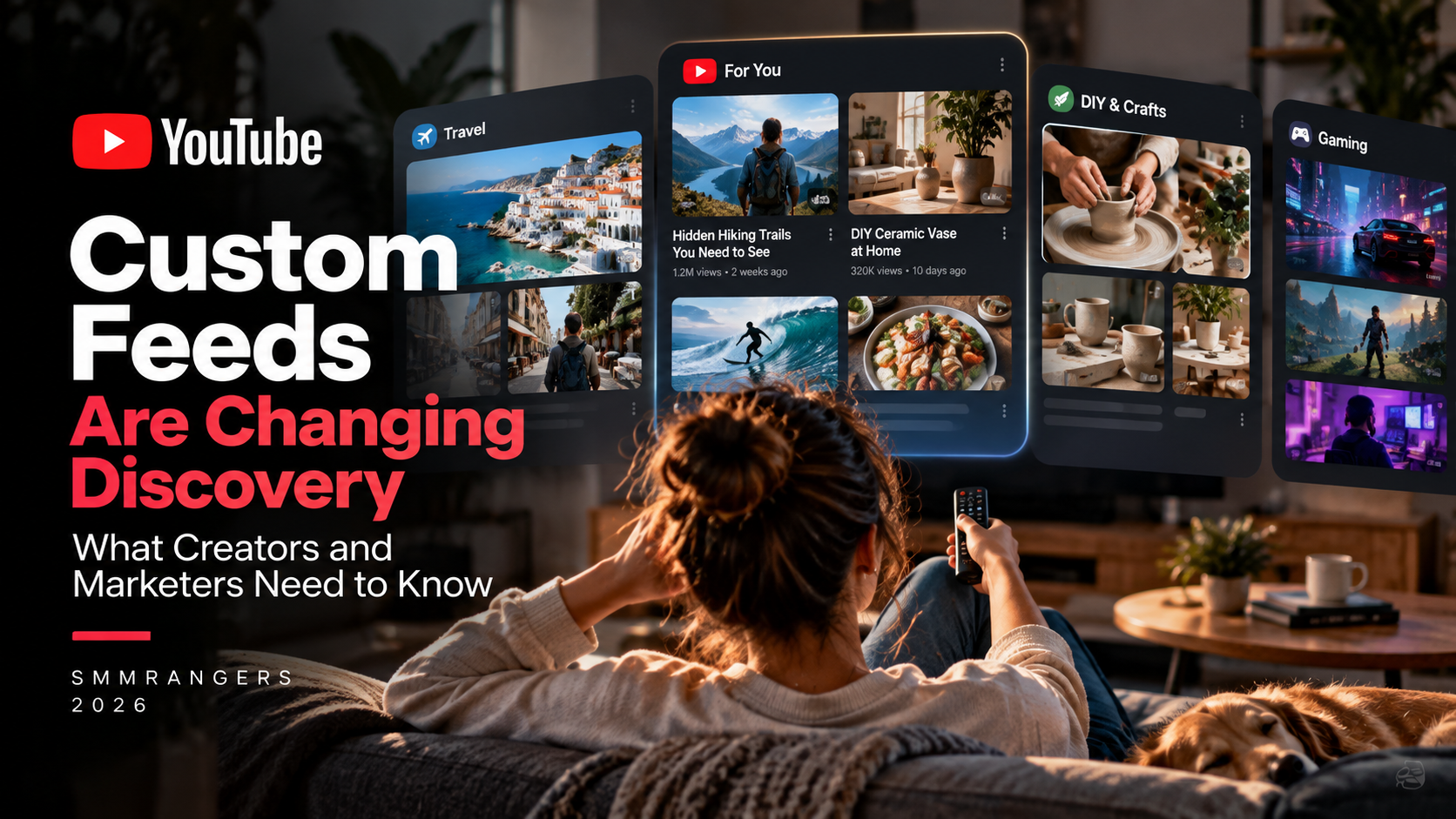
YouTube Custom Feeds Are Changing Discovery: What Creators and Marketers Need to Know
YouTube Custom Feeds give viewers more direct control over discovery by letting them create personalized feeds around specific interests, moods or topics. For creators, the important change is not a new “algorithm hack.” It is another sign that YouTube discovery is becoming more intent-driven—and that views, subscribers, relevance, engagement and viewer satisfaction are different parts of channel growth.
YouTube has spent years trying to predict what people want to watch.
Now it is giving viewers another way to simply tell it.
At Made on YouTube 2026, YouTube introduced Custom Feeds, a new discovery feature that allows viewers to curate personalized homepage feeds around their interests or mood.
At first glance, that sounds like a quality-of-life update.
For creators and marketers, however, it raises a much more interesting question:
What happens when viewers can describe the content they want instead of waiting for the recommendation system to infer it?
The answer could matter for how creators think about niches, topics, audience relevance—and even what “YouTube growth” actually means.
What Are YouTube Custom Feeds?
Custom Feeds allow viewers to create separate recommendation feeds based on what they want to watch.
Instead of relying exclusively on the standard personalized homepage, a viewer might create a feed around a particular interest.
Think:
beginner woodworking projects
new travel creators
home workouts
ceramic tutorials
independent game reviews
or a more specific combination of interests.
YouTube then uses that intent to create a dedicated discovery environment.
The existing homepage does not disappear.
Custom Feeds add another layer.
That distinction is important because YouTube already personalizes recommendations heavily.
Its recommendation system considers signals such as watch history, search history, subscriptions, likes, dislikes and explicit feedback including “Not interested.”
Custom Feeds make viewer intent more explicit.
Instead of YouTube only asking:
“What does this viewer probably want?”
the viewer can increasingly say:
“Show me more of this.”
Why Custom Feeds Matter for Creators
Creators have traditionally thought about YouTube discovery through several major surfaces:
Home,
Search,
Suggested/Up Next,
Shorts,
Subscriptions,
and topic or destination pages.
Custom Feeds introduce another discovery context.
That does not mean creators suddenly need an entirely new strategy.
But it reinforces something YouTube has been telling creators for years:
The platform is trying to match videos with viewers who are likely to want and enjoy them.
YouTube's own creator guidance describes recommendation performance through three broad ideas:
Appeal: Did people choose to watch?
Engagement: Did they continue watching?
Satisfaction: Did they enjoy the experience?
That framework matters more than trying to reverse-engineer a mysterious algorithm.
Custom Feeds make the same principle easier to see.
If someone explicitly creates a feed around a subject, content that genuinely serves that subject has a logical discovery advantage over content that merely tries to look popular.
YouTube Discovery Is Becoming More Intent-Driven
Search has always contained explicit intent.
Someone searches:
“how to glaze pottery”
and YouTube knows exactly what they asked for.
Home recommendations work differently.
YouTube has historically had to infer interest from behavior.
A viewer watches three pottery videos.
They subscribe to two ceramic artists.
They search for a kiln review.
YouTube learns.
Custom Feeds create a bridge between these systems.
The viewer provides an explicit topic or interest, while YouTube still uses recommendation technology to populate the feed.
This creates a useful model:
Search = “Find this for me.”
Traditional recommendations = “Predict what I might want.”
Custom Feed = “Build a discovery environment around this interest.”
For creators, that makes topical clarity increasingly important.
Does This Mean Niches Matter More?
Potentially—but not in the simplistic sense that every creator should choose one microscopic topic and never leave it.
YouTube itself encourages creators to think about audiences rather than obsessing over “the algorithm.”
The real question is:
Can YouTube—and more importantly, viewers—understand who this content is for?
Imagine two channels.
Channel A
Uploads:
gaming today,
personal finance tomorrow,
a travel vlog next week,
then a random product review.
Channel B
Creates content around:
budget travel,
cheap flights,
destination guides,
travel mistakes,
and affordable accommodation.
Channel B gives both viewers and recommendation systems a clearer thematic relationship between videos.
That does not automatically guarantee more views.
But it creates a stronger content identity.
Custom Feeds make that identity even more interesting because viewers may increasingly build discovery environments around precisely those interests.
Subscribers Still Matter—But They Are Not the Whole Discovery System
This is where social media metrics become easy to misunderstand.
A subscriber represents someone who has chosen to follow a channel.
That matters.
Subscriptions are also one of the signals YouTube says can inform recommendations.
But subscribing does not mean every subscriber will see or watch every upload.
Likewise, YouTube discovery is not limited to subscribers.
A video can reach people who have never encountered the creator before.
This is why these concepts should remain separate:
Subscribers = audience connection
Views = consumption volume
Watch behavior = attention
Engagement = audience response
Recommendation = distribution opportunity
Custom Feed discovery = interest-driven discovery context
They interact.
They are not interchangeable.
Getting Views and Getting Recommended Are Not the Same Thing
This distinction is particularly important for marketers and SMM users.
A view measures a view.
It does not automatically tell you why the viewer arrived.
Traffic can come from many sources:
Home,
Search,
Suggested Videos,
Shorts,
subscriptions,
external websites,
advertising,
embeds,
direct links,
and other discovery surfaces.
That means:
More views ≠ proof of more recommendation traffic.
Likewise:
More subscribers ≠ guaranteed recommendation distribution.
YouTube explicitly says its recommendation system considers viewer personalization and how content performs when presented to viewers.
According to YouTube's current creator guidance, performance includes whether people choose to watch, continue watching and appear satisfied afterward.
There is no credible basis for promising:
“Increase this visible number and YouTube will automatically recommend your video.”
Those are different mechanisms.
What Custom Feeds Mean for YouTube SEO
Custom Feeds also make an old YouTube principle increasingly relevant:
Describe your content accurately.
YouTube Search already evaluates how well elements such as the title, description and video content match a viewer's search.
But semantic understanding across YouTube is becoming more sophisticated.
Custom Feeds arrive alongside broader AI-powered discovery tools such as Ask YouTube, which allows viewers to make more complex conversational requests.
This suggests a wider shift:
keyword matching → topic understanding → viewer intent
Keywords are not disappearing.
But creators should think beyond repeating phrases in titles and descriptions.
The real objective is to make the topic unmistakable.
For example, instead of producing ten unrelated videos targeting isolated keywords, a creator might build a connected content cluster:
YouTube Shorts Growth
→ How Shorts Recommendations Work
→ Shorts Views vs Watch Time
→ How to Build a Shorts Series
→ Shorts Retention Explained
→ Why Shorts Views Suddenly Drop
That creates topical depth for viewers.
And increasingly, discovery systems have more context to work with too.
What Should Creators Do Now?
1. Make your channel's subject easier to understand
Look at your last 20 videos.
Could a new viewer describe what your channel is about?
If not, your content strategy may be too fragmented.
2. Build topic clusters instead of isolated videos
When one subject performs well, explore adjacent questions.
A strong video can become the beginning of an information ecosystem.
3. Optimize for the click—but deliver after it
Titles and thumbnails still matter because viewers must choose to watch.
But a click without sustained attention is incomplete.
YouTube's own performance framework considers both appeal and engagement.
4. Watch traffic sources separately
Do not look only at total views.
YouTube Analytics can help show where viewers are discovering content.
A video receiving 100,000 views primarily through external traffic tells a different story from one receiving strong Home or Suggested distribution.
5. Study returning viewers
Discovery gets someone through the door.
Returning viewers indicate whether there is a reason to come back.
Those are different stages of growth.
6. Stop looking for one magic metric
Subscribers matter.
Views matter.
Watch time matters.
Engagement matters.
Audience satisfaction matters.
But none alone describes the entire channel.
What This Means for SMM Services
Social media marketing services are also easier to evaluate when these distinctions are clear.
A YouTube views service targets views.
A subscriber service targets subscriber count.
A likes service targets likes.
Those are visible social metrics.
They should not be represented as guaranteed ways to generate:
organic recommendation,
viewer satisfaction,
watch retention,
sales,
or long-term community growth.
That does not make visible metrics meaningless.
It means they should be used according to the objective they actually address.
Someone researching YouTube views, for example, may want to understand pricing, order mechanics or how view services work.
Our guide to buying 1,000 YouTube views addresses that specific commercial question.
But that question is different from:
“How do I make YouTube recommend my videos?”
Good growth strategy starts by separating the two.
Why This Distinction Matters for SMM Resellers
For resellers, misunderstanding the difference creates unnecessary customer-support problems.
A customer purchases views.
Then asks:
“Why didn't my organic reach explode?”
Another purchases subscribers.
Then asks:
“Why doesn't every new upload receive the same number of views?”
The service may have delivered exactly the metric described while the customer's expectation involved an entirely different outcome.
Clear service descriptions therefore matter.
A reseller should explain:
what the service delivers,
what delivery conditions apply,
whether refill is available,
what the expected speed is,
and importantly,
what the service does not guarantee.
As platforms make recommendation systems more sophisticated, expectation management becomes part of service quality.
Quality vs Quantity in YouTube Growth
Imagine two videos.
Video A
100,000 views
Weak retention
Few returning viewers
Low engagement
Poor audience fit
Video B
25,000 views
Strong retention
Active comments
Relevant viewers
Meaningful returning audience
Which is better?
There is no universal answer.
If the campaign objective was pure visibility, Video A may have delivered more exposure.
If the objective was building a loyal niche audience, Video B may be more valuable.
This is precisely why raw numbers need context.
Quantity tells you how much.
Quality helps explain what happened afterward.
A serious YouTube growth strategy needs both.
Where SMMRangers Fits
SMMRangers provides social media marketing services for YouTube and other major platforms for individual users, marketers, agencies and resellers.
Users researching YouTube growth can compare currently available options through the SMMRangers Services page.
But service selection should begin with the objective.
Do you need:
visibility?
subscriber count?
engagement?
a particular campaign metric?
or organic audience development?
Those are not automatically the same problem.
The more sophisticated YouTube discovery becomes, the more important that distinction becomes.
Frequently Asked Questions
What are YouTube Custom Feeds?
Custom Feeds are personalized YouTube discovery feeds that viewers can curate around specific interests or moods. YouTube announced them at Made on YouTube 2026 as another way for viewers to shape what they discover.
Do Custom Feeds replace the YouTube homepage?
No. They add additional personalized discovery experiences rather than eliminating YouTube's standard homepage.
Will Custom Feeds change the YouTube algorithm?
They add another way for viewers to communicate their interests, but YouTube has not announced that its fundamental recommendation principles are being replaced. Current YouTube guidance still emphasizes personalization, content performance and viewer satisfaction.
How does YouTube decide which videos to recommend?
YouTube says recommendations use signals including viewing and search history, subscriptions, likes, dislikes and explicit feedback. Content performance and relevance to viewers also matter.
Do more YouTube views make a video get recommended?
Not automatically. YouTube says recommendations depend on viewer personalization and performance factors such as appeal, engagement and satisfaction. Total view count alone does not establish that a video will receive more recommendation distribution.
Do subscribers still matter?
Yes. Subscriptions are one of the signals YouTube uses in personalization and they represent an existing connection between a viewer and a channel. But subscribers are only one component of YouTube discovery.
The Bottom Line
Custom Feeds are interesting not because they reveal a new YouTube growth hack.
They reveal where discovery is heading.
YouTube already tries to understand what viewers watch, search for and enjoy. Custom Feeds give viewers another way to express those interests more directly.
For creators, that strengthens the case for:
clear topics,
recognizable content identity,
strong viewer response,
and content that earns attention after the click.
For marketers and SMM users, it reinforces another distinction:
Visible social metrics and algorithmic discovery are related parts of social media growth—but they are not the same thing.
Getting a view is one outcome.
Getting discovered is another.
Getting someone to stay, enjoy the content and return again is another still.
Understanding the difference is becoming one of the most important skills in YouTube growth.