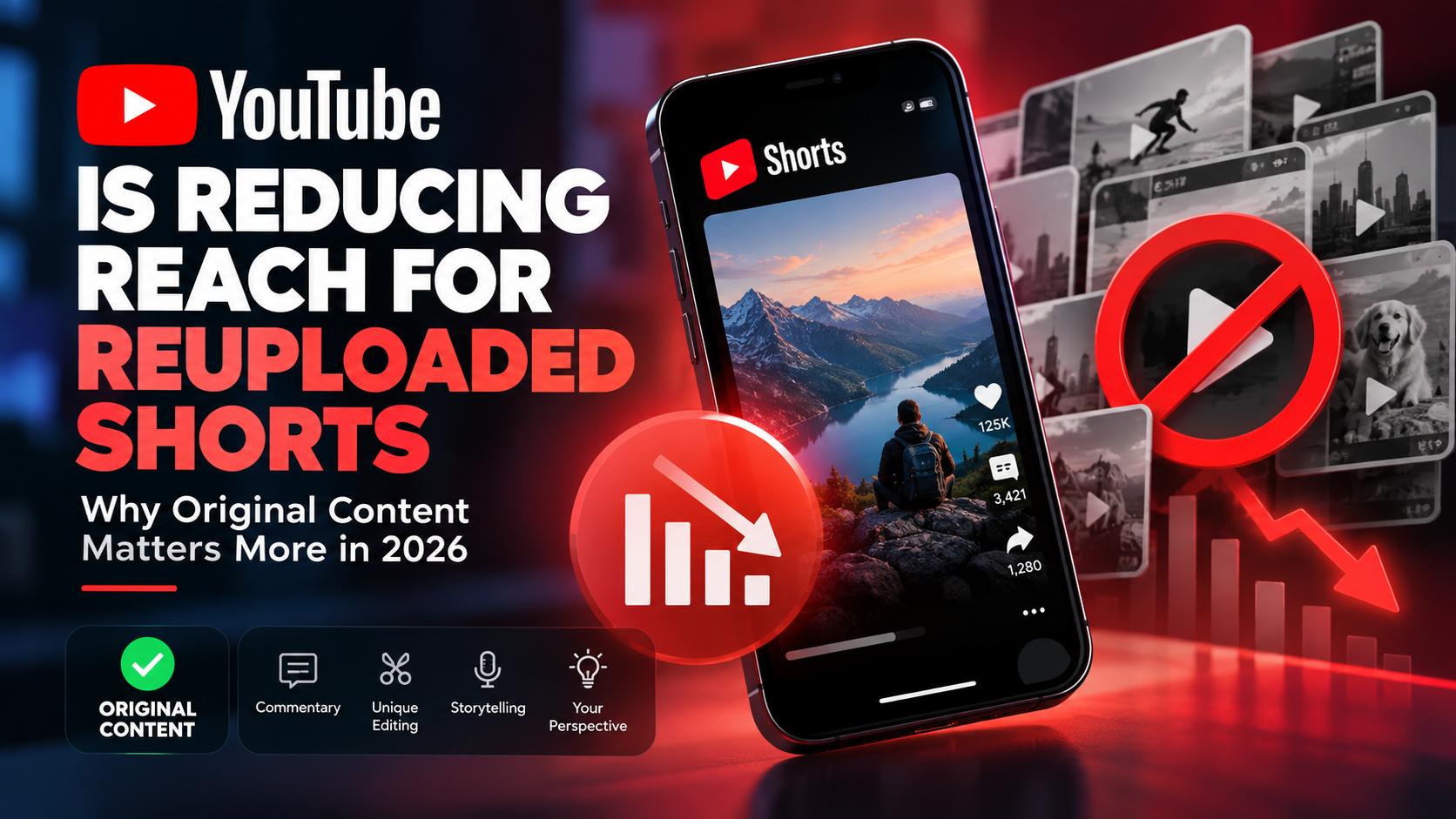
YouTube Is Reducing Reach for Reuploaded Shorts: Why Original Content Matters More in 2026
YouTube is updating its Shorts recommendation systems to further prioritize original content and reduce the reach of channels that primarily re-upload other creators’ videos without meaningful changes.
For creators, marketers and SMM users, the update reinforces an important distinction:
Getting views, earning organic distribution and creating original content are not the same thing.
YouTube Is Changing How Reuploaded Shorts Are Distributed
YouTube has made its position on original Shorts considerably clearer.
In an official announcement published on October 1, 2026, YouTube said it is updating its recommendation systems to further prioritize original content while reducing the reach of content re-uploaded from other creators without meaningful additions.
According to YouTube’s official announcement, channels identified as primarily aggregating or re-uploading other creators’ videos without significant changes will likely receive less distribution in the Shorts feed.
That wording matters.
YouTube is not saying that every video containing someone else’s footage will automatically lose reach.
Instead, the platform specifically points toward channels that primarily aggregate or re-upload other creators’ videos without adding significant value.
YouTube recommends adding elements such as:
original commentary,
unique editing,
storytelling,
or a distinct perspective.
Minor technical changes or template-based edits may not be enough.
For creators who rely heavily on reposted clips, this could have a direct impact on discovery.
And for anyone trying to understand why their Shorts reach has fallen, it adds another variable to consider.
Why Is YouTube Prioritizing Original Shorts?
YouTube says its recommendation systems use many signals to connect viewers with videos they are likely to value.
The new change adds a stronger emphasis on who is actually contributing something original to the Shorts ecosystem.
The basic idea is straightforward:
Original creator → Original Short → Viewer response → Recommendation opportunity
versus:
Existing creator → Re-uploaded clip → Minimal changes → Reduced distribution potential
YouTube says the goal is both to improve the viewer experience and to give creators publishing original material a better opportunity to grow.
This also fits a broader direction across social platforms: recommendation systems increasingly have to distinguish between original creation, meaningful remixing, mass-produced content and simple duplication.
But there is an important distinction here.
This is primarily a recommendation-system change, not an announcement that every reused video will automatically be removed.
A video can exist on YouTube while still receiving limited organic distribution.
That distinction is crucial for understanding Shorts performance.
Reuploaded Content vs Original Content: What Counts?
The obvious question is:
What does YouTube consider original enough?
There is no simple percentage or numerical threshold in YouTube’s announcement.
Instead, YouTube focuses on whether the creator contributes meaningful additional value.
For example, using another creator’s clip while adding substantial commentary, analysis, storytelling or distinctive editing is different from simply downloading the original and uploading it again.
YouTube specifically warns against relying on minor technical edits or template-based changes simply to alter a video.
The platform instead encourages creators to bring their own voice or point of view.
That gives us three useful categories.
1. Original Content
You create the footage, idea, presentation or story yourself.
2. Transformative or Meaningfully Remixed Content
You may incorporate existing material, but you contribute meaningful commentary, editing, storytelling or another original perspective.
3. Simple Reuploads
You primarily republish someone else’s material with little or no meaningful contribution.
The latest recommendation update is particularly relevant to the third category.
YouTube has not published a specific percentage of reuploaded content that triggers reduced distribution.
So claims such as “three reposts will kill your reach” or “X% original content guarantees recovery” should be treated skeptically.
YouTube has not provided those numbers.
Why Are My YouTube Shorts Getting No Views?
This update makes that question more complicated.
When a Short underperforms, creators often assume there must be one explanation:
The algorithm didn’t push it.
But Shorts distribution can depend on many factors.
The video’s topic matters.
Viewer interest matters.
Competition matters.
Audience response matters.
Watch behavior matters.
And now, for channels relying heavily on reuploaded material, originality can also affect distribution.
This means low Shorts reach should not automatically be interpreted as a technical problem.
Nor should every decline be blamed on this update.
YouTube has not provided creators with a simple indicator saying:
“Your Shorts reach was reduced because your channel contains too much reuploaded content.”
That creates an attribution problem.
If Shorts views suddenly decline, creators should examine several possibilities rather than searching for a single explanation.
Views and Organic Reach Are Not the Same Thing
This distinction is particularly important for marketers and users of social media marketing services.
Consider three concepts:
Views
Organic reach
Recommendation
They are related, but they are not interchangeable.
Views
Views describe consumption recorded on a video according to the platform’s measurement rules.
Organic Reach
Organic reach describes how widely content reaches viewers without paid or externally purchased distribution.
Recommendation
Recommendation describes YouTube choosing to surface content through areas such as the Shorts feed or other recommendation surfaces.
A video can receive views without those views necessarily causing YouTube to recommend it to substantially more people.
Similarly, purchasing views does not mean YouTube will automatically increase the video’s organic distribution.
That is why marketers should avoid the equation:
More Views = More Algorithmic Reach
There is no reliable guarantee that this relationship exists.
This becomes even more important when YouTube itself is explicitly changing distribution based on characteristics such as content originality.
Can Buying YouTube Views Fix Low Shorts Reach?
Not in the sense of overriding YouTube’s recommendation systems.
A YouTube views service targets a visible metric: views.
YouTube’s organic recommendation system is a separate mechanism.
If a channel is receiving reduced Shorts distribution because YouTube considers it primarily an aggregator or re-uploader, ordering additional views does not change the originality of the content.
It does not turn a repost into an original video.
And it should not be represented as a guaranteed way to restore organic reach.
This is an important distinction for SMM users.
Purchased social metrics and organic platform distribution solve different problems.
If you’re evaluating view services specifically, our guide to buying 1,000 YouTube views explains pricing, delivery, retention and the practical differences between service types.
The key is understanding what you are buying.
A view service targets view delivery.
It does not purchase a guarantee from YouTube’s recommendation algorithm.
Why This Matters for SMM Panels and Resellers
This update is relevant beyond creators.
It matters for SMM resellers and support teams too.
Imagine a customer says:
“My Shorts are getting no organic reach. Which views service will fix it?”
The easiest response would be to recommend the largest or fastest service.
But that may misunderstand the customer’s actual problem.
Before choosing a service, a reseller should separate two questions:
1. Does the customer want a particular visible metric delivered?
2. Is the customer trying to solve an organic content-distribution problem?
Those are not necessarily the same request.
A service may successfully deliver what its description promises while the Short continues receiving limited organic recommendation.
From an operational perspective, this distinction can reduce unrealistic expectations, unnecessary support tickets, incorrect service recommendations and confusion between service delivery and platform behavior.
For SMM panels, better customer education can therefore be commercially useful.
Selling the correct service for the correct objective is more sustainable than promising outcomes that a provider cannot control.
Cheap Views vs High-Quality Views Still Isn’t the Whole Question
SMM users often compare YouTube services based on:
price,
speed,
retention,
drop rate,
refill,
and maximum order quantity.
Those are legitimate service-level characteristics.
But none answers the separate question:
Will YouTube organically recommend my Short?
That decision belongs to YouTube.
This means service evaluation should happen at two levels.
Service-Level Evaluation
Did the service start correctly?
Was the expected quantity delivered?
What was the delivery speed?
Was there a drop?
Is refill available?
Platform-Level Evaluation
Did organic viewers respond to the content?
Did people continue watching?
Did they interact?
Did the Short receive additional recommendation?
Was the content original enough to remain competitive within the recommendation environment?
Confusing these two layers creates bad decisions.
Originality Is Becoming a Distribution Variable
The bigger story here is not simply:
“YouTube hates reposts.”
The more useful interpretation is that originality itself is increasingly becoming part of distribution strategy.
For years, short-form growth strategies frequently involved identifying successful videos and rapidly recreating or redistributing them.
That strategy becomes less attractive if platforms become better at identifying who created the underlying material and whether subsequent uploads meaningfully transform it.
For creators, that raises the value of:
original ideas,
recognizable formats,
original commentary,
distinctive editing,
creator personality,
and unique storytelling.
These are difficult to reproduce through simple automation.
And that may be exactly the point.
This Does Not Mean Remix Culture Is Dead
Short-form video has always been heavily influenced by remix culture.
Trends spread because people repeat sounds, formats, memes, challenges, editing styles and ideas.
YouTube is not saying creators must operate in isolation.
Its announcement recognizes creative formats using other material.
The dividing line is meaningful contribution.
A creator responding to an existing idea with original commentary is different from an account downloading hundreds of successful clips and reposting them almost unchanged.
That distinction allows YouTube to preserve remix culture while reducing incentives for pure aggregation.
For creators, the strategic question therefore becomes:
What am I adding that makes this version mine?
What Should YouTube Shorts Creators Do Now?
First, audit your recent Shorts.
If a significant percentage consists primarily of other creators’ footage, consider whether you are contributing enough original value.
Second, don’t rely on cosmetic editing.
Cropping a video, changing its speed, adding a border or applying the same template repeatedly should not be assumed to make content original.
Third, strengthen your creator layer.
Add original commentary, analysis, storytelling, on-camera context, voice or genuinely distinctive editing.
Fourth, monitor your Shorts performance over time rather than reacting to a single upload.
One low-performing Short does not prove that your channel has been affected by this change.
Finally, separate your metrics:
Views → Attention → Engagement → Followers → Returning Viewers → Organic Distribution
Do not treat the view counter as the entire growth strategy.
What SMM Resellers Should Do
Resellers should make the same distinction when customers ask for YouTube services.
If the objective is view delivery, evaluate the available view services according to their actual characteristics.
If the objective is organic Shorts recovery, investigate the content problem first.
That may include content originality, topic selection, viewer response, upload strategy and recent changes in channel performance.
A useful rule is:
Do not promise an algorithmic outcome when you are selling a metric.
That principle becomes increasingly important as YouTube’s recommendation systems become more sophisticated.
Where SMMRangers Fits
SMMRangers provides social media marketing services for creators, marketers, agencies and resellers across YouTube and other major social platforms.
For YouTube users, the goal should be to choose services based on the metric they actually want to support rather than treating every service as an organic growth solution.
You can explore the current SMMRangers service catalog to compare available options.
But the platform side of the equation still matters.
YouTube controls its own recommendation systems.
Creators control their content.
SMM services provide specific forms of delivery.
Understanding where one ends and another begins leads to better decisions.
Frequently Asked Questions
Is YouTube Reducing the Reach of Reuploaded Shorts?
Yes. YouTube announced on October 1, 2026 that its Shorts recommendation systems are being updated to further prioritize original content and reduce the reach of content re-uploaded from other creators without meaningful additions.
You can read YouTube’s official explanation here.
Will Every Reposted Short Lose Reach?
YouTube has not said that every individual reused clip will automatically receive reduced reach.
Its announcement specifically refers to channels identified as primarily aggregating or re-uploading other creators’ videos without significant changes.
Does Adding Captions Make a Repost Original?
Not necessarily.
YouTube encourages meaningful original contribution such as commentary, unique editing, storytelling or a distinct point of view.
Minor technical or template-based changes should not automatically be assumed to qualify.
Why Are My YouTube Shorts Suddenly Getting Fewer Views?
There can be many causes, including audience interest, competition, content performance and changes in recommendation.
Channels relying heavily on reuploaded content now have another factor to consider, but a decline alone does not prove that YouTube has classified a channel as an aggregator.
Can Buying YouTube Views Restore Organic Shorts Reach?
A views service can target view delivery, but it cannot guarantee that YouTube will increase organic recommendation.
If reduced distribution is related to content originality, purchasing views does not change the originality of the Short.
Are YouTube Views Still Important?
Views remain an important measure of video consumption and visible activity.
But views alone do not describe retention, engagement, follower conversion or organic recommendation.
Can I Still Use Clips From Other Creators?
YouTube’s announcement does not prohibit all use of other creators’ clips.
It emphasizes adding meaningful original value through commentary, editing, storytelling or another distinct perspective.
Copyright and other YouTube policies still apply separately.
The Bottom Line
YouTube’s latest Shorts update reinforces a larger shift happening across social media:
Distribution is becoming harder to separate from originality.
For creators, copying what already works may no longer be enough.
For marketers, a large view number should not automatically be interpreted as strong organic distribution.
And for SMM users, purchased metrics should not be confused with control over recommendation algorithms.
The most useful way to think about Shorts growth in 2026 is therefore not:
“How do I get more views?”
but:
“Where are my views coming from, what happens after the view, and is my content giving YouTube a reason to keep distributing it?”
That is a much better foundation for sustainable YouTube growth.