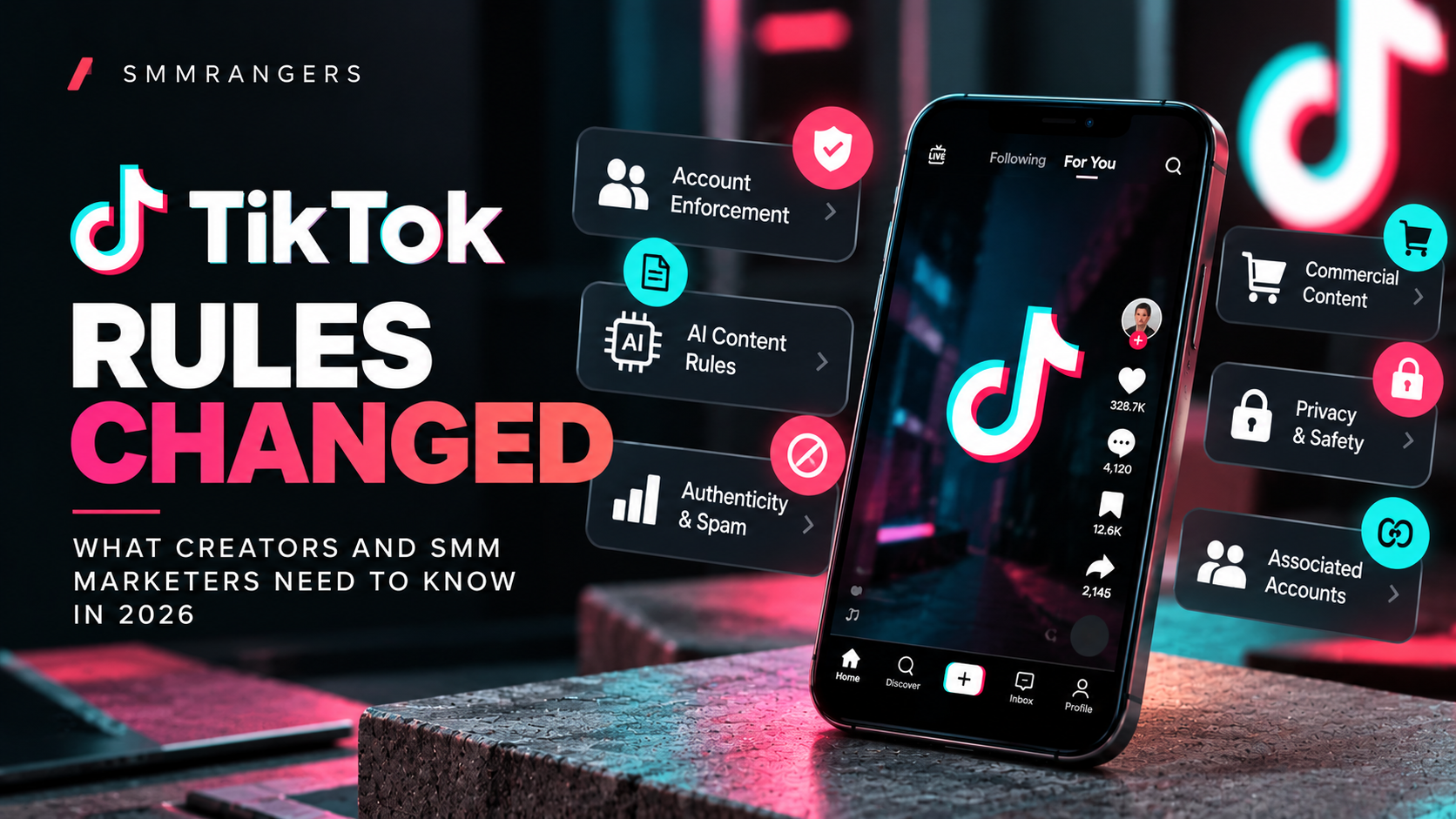
TikTok Community Guidelines 2026: What Creators and SMM Marketers Need to Know
TikTok’s updated Community Guidelines took effect on September 24, 2026. The update does not rewrite everything creators know about TikTok, but it makes several enforcement and account-level rules worth revisiting. At the same time, TikTok is strengthening its efforts around AI-generated spam, authenticity and transparent content. For creators, agencies and SMM users, the practical lesson is simple: growth metrics and platform compliance need to be managed separately.
TikTok changes constantly.
That makes every new policy update vulnerable to the same problem: within hours, social media fills with claims that “the algorithm changed,” certain content is now banned, or every creator needs to completely change strategy.
The September 2026 Community Guidelines update deserves a more careful reading.
TikTok’s new guidelines became effective on September 24. Some rules are genuinely different or more explicit. Others—including important rules around authenticity and AI-generated content—are continuations of policies TikTok already had.
Understanding that distinction matters.
Because for creators, marketers, agencies and people using social media marketing services, reacting to a rule that never actually changed can be just as unhelpful as ignoring one that did.
What Changed in TikTok’s September 2026 Community Guidelines?
TikTok released the updated version of its Community Guidelines in August, with the new rules taking effect September 24, 2026.
The guidelines continue to cover major areas including:
- account and feature enforcement,
- integrity and authenticity,
- For You feed eligibility,
- commercial activities,
- privacy and security,
- youth safety,
- misinformation,
- and platform enforcement.
But one of the most relevant changes for marketers involves how TikTok describes enforcement at the account level.
The updated rules provide more detail around restrictions, bans and associated accounts.
This matters particularly for people operating multiple accounts.
An enforcement action should no longer be viewed purely as an isolated content-level event.
TikTok can evaluate account behavior more broadly, including associated accounts in certain circumstances.
For agencies, creator networks and anyone managing multiple TikTok properties, that makes account-level compliance more important.
Not Everything You Are Hearing Is Actually New
This distinction is important.
You may have seen headlines suggesting that TikTok suddenly introduced completely new AI-content rules on September 24.
That framing is misleading.
Rules around AI-generated and significantly AI-edited content already existed before this update.
Likewise, TikTok’s broader emphasis on authenticity did not suddenly begin in September 2026.
What has changed is the environment around those rules.
AI-generated content is becoming dramatically easier to produce at scale.
That means platforms increasingly have to distinguish between useful AI-assisted creativity and automated content production that overwhelms users with repetitive or low-value material.
TikTok itself provided another important update on September 24.
The company said it is testing improved detection systems aimed at accounts dedicated to posting AI-generated spam that crowds out original creators.
That development may ultimately matter more to many marketers than the wording of a single Community Guidelines clause.
TikTok Is Not Fighting AI. It Is Fighting Low-Trust AI Use
It would be easy to interpret TikTok’s direction as:
AI content is bad.
That is not what the platform is saying.
TikTok continues to support AI-assisted creation and has invested heavily in AI tools.
The issue is transparency and abuse.
There is a major difference between:
using AI as part of the creative process
and
operating accounts designed to flood the platform with mass-generated spam.
For legitimate creators and marketers, this distinction is important.
AI can help with:
- ideation,
- editing,
- translation,
- dubbing,
- visual production,
- scripting,
- and content repurposing.
But automation does not eliminate the need for originality, relevance or audience value.
That is increasingly becoming a central theme across social platforms.
What Does TikTok Mean by Authenticity?
TikTok’s Integrity and Authenticity rules are designed around the idea that users should be able to understand what they are seeing and who they are interacting with.
This includes rules dealing with areas such as:
- deceptive behavior,
- fake identities,
- platform manipulation,
- misinformation,
- artificial engagement,
- and certain forms of automated behavior.
For marketers, this creates an important distinction:
Growth is not the same thing as manipulation.
A creator can actively market an account.
A brand can run advertising.
A business can work with creators.
A marketer can analyze and optimize social metrics.
And users may purchase social media marketing services.
But none of those activities make TikTok’s platform rules disappear.
The objective should therefore never be:
“How do I make activity invisible to TikTok?”
A better question is:
“What exactly does this service change, and does my overall strategy remain consistent with the platform rules I am operating under?”
Why This Matters for SMM Users
This is where the Community Guidelines become particularly relevant to the SMM industry.
People often talk about “TikTok growth” as if it were one product.
It is not.
Consider these objectives:
- increasing a visible follower count,
- generating views on a particular video,
- increasing likes,
- improving audience retention,
- creating conversation,
- building organic followers,
- increasing sales,
- reaching the For You feed.
These are different outcomes.
An SMM service targeting one metric should not automatically be expected to produce all the others.
For example:
Follower service → targets follower count.
View service → targets views.
Like service → targets likes.
None of those automatically guarantees organic distribution, audience retention, sales or long-term community growth.
That distinction becomes even more important when platforms strengthen authenticity and spam enforcement.
Artificial Engagement Is Still a Platform Risk
TikTok’s guidelines prohibit attempts to manipulate engagement or its recommendation systems.
That means marketers should be careful with claims suggesting that a particular SMM service is:
“undetectable,”
“100% safe,”
“algorithm-proof,”
or guaranteed to trigger organic reach.
Those claims are difficult to substantiate and can misrepresent what the service actually provides.
A better way to evaluate an SMM service is operationally.
Ask:
What metric does it provide?
What is the expected delivery behavior?
What are the refill terms?
What happens if delivery becomes unstable?
What does the service description actually promise?
What does it explicitly not promise?
That is a much more useful framework than trying to guess how a platform’s internal detection systems work.
Why TikTok Services Can Become Unstable After Platform Updates
This is also where platform updates intersect with something SMM buyers experience directly:
service instability.
TikTok does not publish a notice saying:
“Third-party follower services will stop working today.”
Instead, changes to platform systems can affect the infrastructure providers rely on.
The result may appear downstream as:
- slower delivery,
- orders remaining in processing,
- higher drop rates,
- failed orders,
- refill delays,
- or services being temporarily disabled.
That does not prove that every service interruption is caused by a TikTok update.
Providers can experience their own technical or supply problems.
But when a major platform changes detection, security or account systems, instability across parts of the SMM supply chain is possible.
This is why experienced resellers pay attention not only to price but also to service stability.
Cheap Does Not Always Mean Better
Imagine two TikTok follower services.
Service A
Very low price
Extremely fast delivery
Frequent drops
Unstable availability
Weak refill performance
Service B
Higher price
More predictable delivery
Clear service description
Better historical stability
Defined refill conditions
Looking only at cost per 1,000 makes Service A appear better.
Operationally, it may be worse.
For a reseller, failed orders create:
support tickets,
refund requests,
manual intervention,
customer dissatisfaction,
and lost time.
That means the real cost of a service is not simply:
provider price.
It is closer to:
Provider Cost + Drop Risk + Support Cost + Refund Risk + Operational Time
This becomes especially relevant during periods when TikTok services are unstable.
What Should SMM Resellers Do After a Major TikTok Update?
1. Monitor services more closely
Do not assume yesterday’s best-performing service is automatically today’s best-performing service.
Track recent orders.
Look for changes in:
- start time,
- completion rate,
- drop behavior,
- refill performance,
- and failure rate.
2. Test before scaling
When a service becomes unstable, smaller test orders can provide useful operational information before routing significant customer volume through it.
3. Read service descriptions again
Providers may change:
- speed,
- minimum quantity,
- maximum quantity,
- refill terms,
- or service notes.
A service ID remaining the same does not necessarily mean the service conditions have remained identical.
4. Avoid promises you cannot control
If a provider says an order normally starts within a certain range, do not convert that into an absolute customer guarantee unless you can actually guarantee it.
Platform and provider conditions can change.
5. Separate delivery problems from content problems
If a customer says:
“My TikTok isn’t growing,”
first identify what they actually mean.
Is the order not delivering?
Are followers dropping?
Are videos getting fewer organic views?
Is engagement weak?
Is the account restricted?
Those are completely different problems.
6. Keep backup services
Depending on a single provider or service can become an operational weakness during periods of instability.
Resellers should understand their alternatives before they need them.
What Creators and Marketers Should Do Now
The lesson for creators is slightly different.
Review your content workflow
If AI plays a major role in content creation, understand TikTok’s disclosure requirements and use the platform’s labeling tools where required.
Avoid mass-produced repetition
AI makes it possible to create enormous quantities of content.
That does not mean publishing enormous quantities is automatically a good strategy.
TikTok has explicitly said it is testing improved detection aimed at AI-generated spam accounts.
Protect account quality
Do not evaluate growth only by follower count.
Watch:
- views,
- engagement,
- retention,
- returning viewers,
- content consistency,
- and audience relevance.
Our guide [TikTok Followers vs Engagement: Why Follower Count Is No Longer Enough in 2026] explores this distinction in more detail.
Understand what paid growth can and cannot do
Paid social metrics and organic audience development solve different problems.
If you are researching follower growth specifically, our How to Get 1,000 Followers on TikTok guide covers organic growth and follower milestones.
For users trying to understand the actual purchasing workflow, How to Buy TikTok Followers explains how follower services work, what buyers should compare, and what risks need to be considered.
Where SMMRangers Fits
SMMRangers provides social media marketing services for resellers, agencies, marketers and individual buyers across TikTok and other major platforms.
The important word here is services.
A service should be evaluated according to what it actually provides.
It should not be treated as a guarantee of:
organic growth,
algorithmic recommendation,
account safety,
sales,
or long-term audience quality.
For current TikTok options, buyers can compare available services, pricing and service descriptions through the SMMRangers Services page.
During periods of platform instability, service selection becomes even more important.
Price matters.
But reliability, delivery behavior, refill conditions and clear expectations matter too.
TikTok Growth in 2026 Requires Two Different Strategies
The mistake is trying to collapse everything into one growth strategy.
Creators and marketers actually need two.
Content strategy
This includes:
content quality,
hooks,
retention,
audience relevance,
consistency,
creative experimentation,
and community.
Distribution and growth strategy
This can include:
organic discovery,
collaborations,
advertising,
creator partnerships,
cross-platform distribution,
and social media marketing services.
Those two systems can support each other.
But they cannot replace each other.
A follower count cannot repair weak content.
Great content cannot guarantee that every distribution campaign will succeed.
And no third-party growth service can override TikTok’s Community Guidelines.
Frequently Asked Questions
When did TikTok’s new Community Guidelines take effect?
TikTok’s updated Community Guidelines became effective on September 24, 2026.
Did TikTok introduce new AI-content rules in September 2026?
Not entirely. Important rules around AI-generated and significantly edited content existed before the September update. TikTok has, however, continued expanding its AI transparency efforts and said on September 24 that it is testing improved detection systems aimed at accounts dedicated to AI-generated spam.
Is AI-generated content banned on TikTok?
No. TikTok permits many forms of AI-assisted content, subject to its content rules and labeling requirements. The platform distinguishes between legitimate AI creativity and prohibited or problematic uses such as deceptive content and spam.
Can TikTok restrict multiple accounts?
TikTok’s updated enforcement language gives the platform scope to act against associated accounts in certain circumstances. People operating multiple accounts should therefore treat enforcement as an account-network consideration rather than assuming every account is completely isolated.
Do TikTok updates affect SMM services?
They can, but a specific service problem should not automatically be attributed to a platform update. Platform security or detection changes can affect provider infrastructure, while provider-side technical problems can independently cause slow, failed or unstable delivery.
Are TikTok followers and organic engagement the same thing?
No. Follower count measures one visible metric. Organic engagement, watch behavior, audience relevance and content performance are separate measurements.
The Bottom Line
TikTok’s September 2026 Community Guidelines update is important—but not because TikTok suddenly rewrote the rules of social media growth.
The bigger story is the direction of travel.
TikTok is continuing to invest in authenticity, transparency, enforcement and systems designed to identify low-quality or abusive activity—including AI-generated spam.
For creators, that means content quality and compliance matter.
For marketers, it means understanding what each metric actually represents.
For SMM resellers, it means reliability and accurate customer expectations become increasingly important whenever platform conditions change.
And for anyone building on TikTok, the most useful principle may be the simplest:
Growth strategy and platform compliance are two different jobs. You need to manage both.